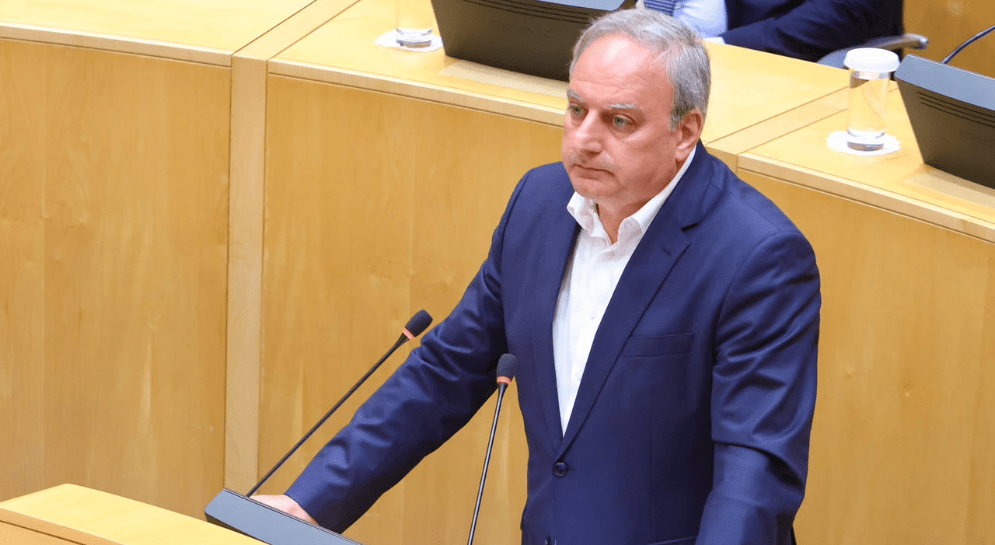
Speech by the General Secretary of AKEL Stefanos Stefanou at the House of Representatives’ commemorative session condemning the coup and invasion
15 July 2026, AKEL C.C. Press Office, Nicosia
It was very early in the morning—I don’t remember the exact time—when I heard the roar of airplane fighter jets flying overhead above our house in (now occupied) Gerolakko village. We went outside and, looking up at the sky, we saw a large number of Turkish transport planes flying slowly and low over my village, circling over the neighbouring Turkish Cypriot village of Kioneli and dropping the paratroopers they were carrying into the area unhindered. It was 20 July 1974, and it was now clear that the Turkish invasion had begun.
The Turkish invasion—which, as a child at the time, I had heard adults discuss in their political conversations. It was well known—it was a widely held belief at the time—that if a coup were staged to overthrow Makarios, a Turkish invasion would subsequently follow. And yet the Greek military junta, together with the murderous, far-right organization EOKA B—founded by Grivas in 1971—proceeded to carry out the coup that led to Turkey’s invasion. This is why the claims of those forces and circles who are trying to whitewash EOKA B and the Greek junta by calling the coup a “reckless act” are completely unfounded.
Glafkos Clerides had called Grivas a “murderer” in his testimony before the Cypriot Parliament’s Committee on the Cyprus File on April 25, 2007. And yet even today, fifty-two years after the Turkish invasion and fifty-two years of ongoing Turkish occupation—a fact of which we are reminded daily by the crescent of shame on the Pentadaktylos mountain range— there are political parties and organizations that honor the murderer Grivas as a hero.
The coup by the Greek junta and EOKA B was carried out not only to give Turkey a pretext to invade, but also to facilitate the landing of its troops and their advance, spreading death and destruction in their wake. That is why, during the first critical hours of “Operation Attila” as it was termed, the coupists did not permit any meaningful resistance to take place.
The coupists national betrayal was immense! The extent of this is also evident from what the Greek junta dictator Dimitris Ioannidis said at session of the War Council, which was belatedly convened in Athens on the very day of the Turkish invasion: “…Let them [the Turkish army] advance. Once they take the port, Kyrenia, and link up with Nicosia, then they’ll stop—we’re certain of that.” The invaders, however, despite Dictator Ioannidis’s cast-iron certainty, did not stop. They captured Lapithos and Karava and subsequently reached Apostolos Andreas, Famagusta, and Morphou. The invaders did not stop until they had captured 37% of the territory of the Republic of Cyprus.
The coup and the Turkish invasion were two sides of the same plan to partition Cyprus—a plan that Turkey has been trying to impose over time. This plan was decided upon at the NATO Foreign Ministers’ Summit in Lisbon in 1971, with the participation of junta-ruled Greece and the military junta in Ankara, as documents substantiate records from that period.
The same NATO, which various circles and politicians both inside and outside Cyprus are now attempting to position as a guarantor of our country and people within the framework of a solution to the Cyprus problem. “NATO has changed now,” some claim in their statements. However, those who support this view should take the time to at least take one look at the recent NATO Summit in Ankara. There, the strategic role that NATO members assign to Turkey was demonstrated yet again. They met all of Turkey’s demands.
Are we going to consent once again to Turkey playing the role of guarantor for Cyprus through NATO this time? Especially when the Greek Cypriot side’s long-standing position is the abolition of the guarantee system?
We in AKEL will once again stand against this, just as we stood against the terror of EOKA B, the treacherous coup, and the Turkish invasion—with AKEL members, alongside other ordinary people, on the front lines of the struggle.
On the occasion of today’s House of Representatives event to denounce these black anniversaries, on behalf of AKEL, we pay tribute to the fallen heroes who tried to resist “Operation Attila”, virtually unarmed and betrayed.
We honor our missing persons and enclaved compatriots, whose presence serves as a reminder to all of whom our occupied territories belong.
We honor the prisoners of war, the wounded, and the disabled veterans, as well as all the soldiers who either rushed to enlist as reservists or were serving their mandatory military service and defended the freedom and territorial integrity of our homeland.
We honor the refugees and all those who suffered from the barbarity of war—and, above all, the women who were raped and who still bear the deep psychological scars of their abuse.
We also honor the heroic fighters of the Democratic Resistance, who stood their ground against the terror and fascism of Grivas’s EOKA B and against the treacherous coup d’état to save Cyprus from impending disaster.
Truly honoring all of them always involves defending the historical truth against the distortion being attempted by those who wish to conceal their faction’s grave responsibility for the destruction of Cyprus. It lies in preserving historical memory in the face of amnesia.
Dear colleagues,
The significance of historical anniversaries is not confined merely to highlighting events or paying due tribute to those who struggle for and defend universal human values and ideals. References to historical anniversaries must always be made with an eye to the future. When there is respect for historical truth, then historical experience can serve as a reliable guidepost for the path ahead. And the path ahead is difficult because our country is being threatened by the Turkish occupation.
The historical truth, in the case of Cyprus, shows that our country was sacrificed to serve NATO interests, which were served by those who indulged in nationalist rhetoric and fascist practices and carried out the coup.
At the same time, however, we cannot overlook the role played in these developments by the illusions that prevailed among the ruling circles of the Greek Cypriot elite during the early years of Cypriot independence. These illusions were linked to the goal of returning to a policy of Enosis rather than supporting the independent bicommunal state, which emerged as a result of the Zurich-London Agreements that these circles had supported. These elites viewed the independent state as undesirable and saw independence as a stepping stone toward Enosis.
Conversely, the ruling elites in the Turkish Cypriot community, with Turkey’s full support, viewed independence as a step toward partition and therefore undermined the independent state.
The newly established bicommunal state lacked the necessary support, and problems arose early on, culminating in the bicommunal clashes of 1963 – ’64 and the first territorial and demographic division with the drawing of the “Green Line” and the creation of Turkish Cypriot enclaves. The failure to uphold what was agreed upon in 1960 and the undermining of the independent bicommunal state created a fertile ground for the conspiracies being hatched against our Cyprus.
Historical experience shows that we must remain consistent to what we agree upon. This historical conclusion—which, it must be said, is not only Cypriot but also universal—must always guide our policy, especially at this time when we are facing the possibility of serious developments surrounding the Cyprus problem.
We must remember what we have agreed upon and reaffirmed on several occasions as the basis for a solution, which is a federal state with political equality.
We must remember that this is what dozens of UN resolutions provide for, and that it is this basis for a solution that the EU supports—and from which we demand assistance so that we may reach a solution that liberates and reunites our country and people..
Developments are shaped by the UN Secretary-General’s intention to convene an informal enlarged meeting aimed at breaking the longest-standing deadlock ever on the Cyprus problem. In light of Mr. Guterres’s intentions, we, as the Greek Cypriot side, must act with determination and confidence, supporting the Secretary-General’s intentions and demonstrate our political will to cooperate fully. We must put forward our position that negotiations should resume from the point at which they were suspended in 2017 at the Crans-Montana Conference, where, according to Mr. Guterres, we had come within just one mile of reaching a strategic agreement.
Resuming the negotiations from where they were suspended presupposes the safeguarding of the convergences that have been recorded, which are numerous and significant. In fact, of the key chapters of the Cyprus problem, the only ones remaining unresolved are property and the issues concerning the withdrawal of the occupying forces, security, and the implementation of the solution.
Safeguarding the convergences and focusing on the remaining open issues not only keeps alive the prospect of solving our national problem, but also shortens the path to a solution. And this can be achieved provided there is the appropriate political will, first and foremost from Turkey, which is exploiting the time to consolidate the status quo of the occupation and promote partition through its policy of establishing two states in Cyprus. This is a policy we will never accept.
But we must be aware that when we call for a review of policy and calling for Bizonal, Bicommunal Federation to be abandoned, we are ultimately serving Turkey’s narrative for a two-state solution.
The question is often asked: Does Turkey want a solution that liberates and reunites?
The only way to test Turkey’s intentions is to hold it accountable by insisting on efforts to resume negotiations from the point where they were suspended. Turkey finds deadlocks convenient, as well as the passage of time, which it exploits to reinforce the status quo of the occupation through illegal colonisation, the selling-off of Greek Cypriot properties, and efforts to alter the character of the Turkish Cypriot community.
We shouldn’t leave Turkey undisturbed and without pressure.
We should exhaust every avenue and every opportunity at our disposal to resume the negotiations with the aim of reaching a speedy solution.
The absence of a solution is not only not a solution, but it harbours dangers for our people —both for Greek Cypriots and Turkish Cypriots. A solution, which will liberate and reunite our country and people, can make our country a bridge of peace, stability, and cooperation in our long-suffering region.
And most importantly, the solution will vindicate the struggles and sacrifices of our people, our heroes, and all the war-stricken people. To achieve this long-awaited solution,
AKEL will continue to devote all its forces, with consistency, perseverance, and creativity to this struggle.