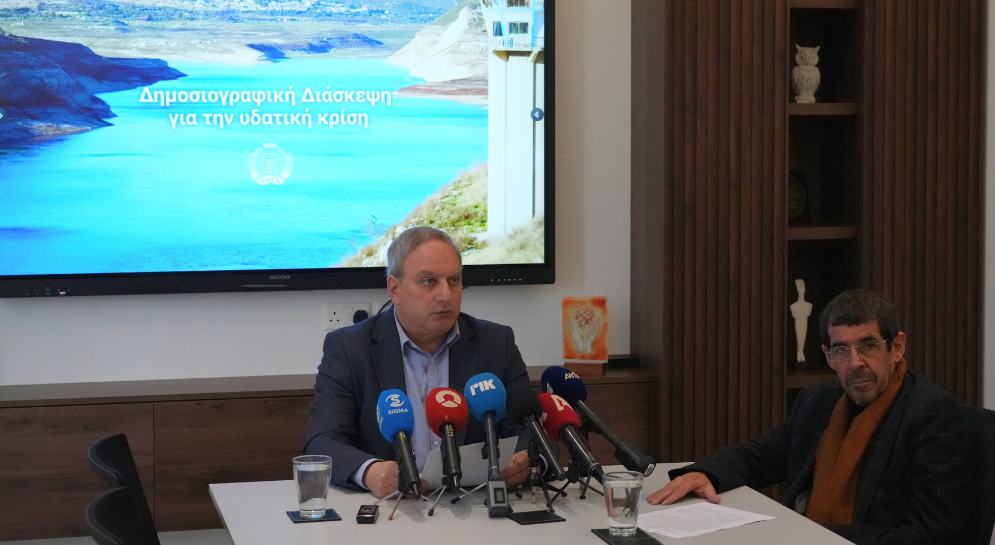
Press conference by the General Secretary of AKEL S.Stefanou on the water crisis
7 February 2026, AKEL C.C. Press Office, Nicosia
Cyprus is facing its worst water crisis in recent years. And, unfortunately, this crisis has caught our country unprepared. The situation has been allowed to reach such a point in recent years that the scenarios for this summer are nightmarish. We are in danger of running out of water and, at the same time, we are also in danger of running out of electricity too, with all the negative—not to say catastrophic—consequences for society, agriculture, crops, and the economy. This is Cyprus in 2026.
Cyprus is unprepared because in previous years, not enough was done to enable us to cope with water shortages, droughts, and low rainfall, which have all existed long ago, but have intensified in recent years due to the climate crisis, which, as scientists predicted, is hitting the Mediterranean particularly hard.
And while all this was well-known, neither the previous Anastasiades-DISY government, nor the current Christodoulides government did what needed to be done to prevent the worst. It was only in May 2024 that the Christodoulides government began to take some measures, which were fragmented and last-minute.
During the previous government’s term:
The Water Development Department had been depleted to such a degree that it lost its ability to carry out its role adequately.
The maintenance of projects, infrastructures and facilities was carried out in a negligent and inadequate manner. It is no coincidence that the problem with the Mavrokolypos dam arose, resulting in the loss of 1.5 million cubic meters of water. The damage was caused by the inadequate maintenance of the dam. The same is true of the water supply network, which has major leaks and losses.
Contracts for desalination plants in previous years were not renewed, resulting in their dismantling. Since then, we have had fewer plants than we need to meet our drinking water needs. And when the dams ran dry, we rushed to find desalination units to meet our needs. Fortunately, the United Arab Emirates agreed to lend us a number of mobile units for two years. And while the needs are pressing, the two units that were scheduled to start operating in early 2026, in Garillis and Limassol Port, are still not ready. In 2026, three more mobile units must be put into operation in Episkopi, Vasilikos, and the Famagusta District, without us knowing when they will be operational.
Existing projects remain unused, such as the recycled water at the processing plant in Tersefanou, because the necessary piping has not been installed. The Solia dam also remains unused due to inadequate piping.
While we have stopped supplying water to farmers, the state continues to supply water to golf courses and big developments through non-transparent procedures and decrees. This is scandalous.
The Christodoulides government’s announcement of water cuts to households will not yield the expected results. Technocrats insist that the cuts will only cause damage and generate major water losses due to outdated systems and networks.
The government’s decision to retroactively impose an environmental tax on farmers only punishes them at a time when they are suffering from high production costs and water shortages.
Cyprus needs a comprehensive water plan that creates the preconditions for effectively addressing a long-standing problem such as water scarcity. Immediate measures need to be taken to improve the situation.
AKEL is resubmitting specific and feasible proposals to address the water crisis. As part of a comprehensive, long-term, and fair water plan, the following must be promoted immediately:
- Ending the allocation of huge amounts of water to golf courses and large developments.
- Acceleration of the connection of the dam to the wastewater treatment plant in Tersefanou and subsequently to the network, as well as connection of the Solias dam. Promotion and completion of projects for the utilization of recycled water from the tertiary processing plant located in Mia Milia.
- Rapid promotion of the implementation of desalination plants, which are a necessary solution, while complying with the laws that provide for public consultation and the preparation of environmental studies for proper spatial planning procedures. In relation to the creation of desalination plants, technologies for the use of renewable energy sources must be promoted in order to reduce costs and emissions. This is necessary because the plants are energy-intensive and polluting.
- Planning for the rational management of water resources, with priority given to conservation and reduction of losses. A more effective campaign to raise water awareness must be developed.
- We need to proceed with immediate maintenance and, where necessary, improvement of existing infrastructures and dams. However, in order to promote this immediately, the Water Development Department needs to be strengthened. As representatives of the TAY reported to Parliament, the inadequate maintenance of dams is primarily due to a lack of personnel and insufficient funding.
- Implementation of mandatory water conservation measures in hotels and large tourist facilities, with priority given to water supply to households and essential services, instead of uncontrolled consumption by large developments.
- Extension of funding to agricultural units for the installation of innovative technologies that enable better use of water resources.
- State investment in water-saving and reuse technologies in public buildings, schools, municipalities, and communities.
- Given that four million tourists are expected in the summer, plans must be made to ensure sufficient water supplies and achieve a balance between tourism development and sustainable water resource management for the benefit of households and the agricultural and livestock sector.
AKEL will continue to remind everyone that water is not a luxury but a social good. It is unacceptable that households, farmers, and society as a whole continue to pay for the shortcomings and incompetence that have brought us to where we are today. We hope that the proposals submitted today will be seriously considered by the government in order to ensure an effective management of the water crisis.