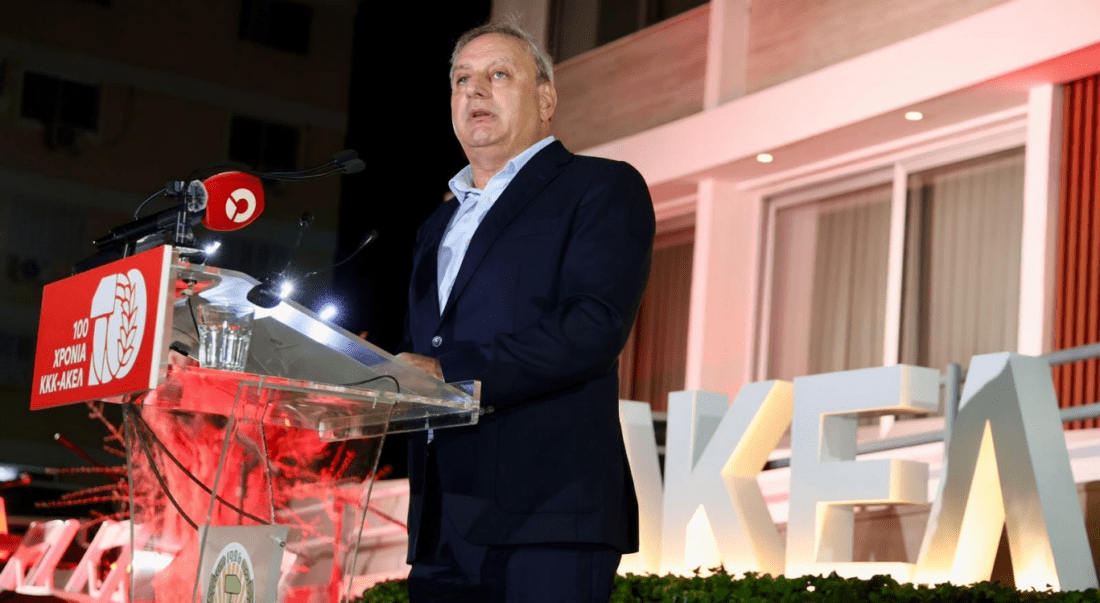
Speech by the General Secretary Stefanos Stefanou on “Social Justice Versus Austerity” at the Meeting of the Left Group in the European Parliament in Cyprus
Speech by the General Secretary Stefanos Stefanou on “Social Justice Versus Austerity” at the Meeting of the Left Group in the European Parliament in Cyprus
3 February 2026, AKEL C.C. Press Office, Nicosia
We live in an era in which the main contradiction that characterizes the capitalist system is becoming increasingly pronounced.
Wealth is increasing, yet the number of poor people is growing.
Technology and productivity are rising, but wages are stagnating.
Economic indicators are steadily rising, but millions of people across Europe live in permanent insecurity, at or below the poverty line.
In 2024, 21% of the European Union’s population (approximately 93.3 million people) was at risk of poverty or social exclusion, or suffered severe material deprivation, or lived in conditions of job insecurity.
Another extremely important factor is that the risk of poverty also extends to a significant proportion of working people. Millions of people who work hard but are unable to secure the basics for their survival.
It is perfectly logical for someone looking at these figures to ask: what went wrong?
This phenomenon is certainly not natural.
It is the obvious result of the political policies pursued by the ruling forces of the European Union in imposing austerity policies on European societies.
“Less state” was the slogan.
More poor people is the result.
Because, as the outcome showed, the purpose of these policies was not to reduce reckless spending, cut red tape, or combat corruption and entanglement.
They took care not to touch them at all.
The attack was frontal and targeted social achievements and rights that supported the broad popular classes and provided relief to those in need.
Austerity is certainly not an economic recipe. It is an ideological political choice that first needs ideological legitimization. So first they tried to convince people on an ideological level that austerity was the only way forward, and then they subsequently imposed austerity policies.
By putting people above numbers.
By sacrificing social cohesion for the sake of securing surpluses.
By treating social policy and the welfare state as a “cost” and “excess expenditure.”
We see the results today.
Workers are paying for crises they did not create.
Societies are burdened with the cost of irrational decisions and wars of “prestige.”
Young people are condemned to live with precarious jobs and low wages.
The elderly suffer silently on the margins of society.
Public health, education, and social welfare systems are undermined and being weakened.
So who won and who lost?
Today, with only the much-vaunted “fiscal discipline” remaining intact, questions hang over the Brussels directorates/ruling elites.
Discipline for whom?
Growth for whom?
Armaments, agreements, and weapons for whose profit?
At a time when the banking system is announcing billions in super profits, at a time when large companies are amassing wealth, societies are under pressure and inequalities are growing.
Consequently, for the peoples, there is no dilemma.
There is only one answer:
Social justice instead of austerity.
Growth and prosperity for all.
Social justice means a fairer distribution of wealth.
It means dignified wages.
It means a strong welfare state.
It means access for all—not just the privileged—to health care, education, housing, and energy sufficiency.
And yes, it means standing up to and clashing with the powerful interests that oppose the public interest.
Confronting dogmas that cripple rights and achievements won through fierce struggle.
Clashing with monopolies that amass wealth at the expense of working people, society, and the country.
Combating government policies that protect exorbitant super profits with all their might and leave workers and their efforts at the mercy of speculation and unbridled greed.
Workers paid the price for the banks’ unbridled greed.
Deposits, wages, and benefits were cut, but profits were not.
Workers continue to pay the price to this day.
Inflation has sent prices skyrocketing, while wages remain stagnant.
Many families are struggling to make ends meet.
Young people cannot find any housing.
A large section of society struggles to make ends meet.
Reality itself is the real economy.
Not any numbers and indicators.
The economy must therefore serve society—not the other way around.
We want growth that is shared fairly.
We want tax justice, so that those who have more contribute more.
We want labour and social rights.
We want a comprehensive social protection framework.
We want a different path for Europe.
Investment in the welfare state.
Policies to tackle inflation.
Labour rights.
Investment in health, education, research, and development.
Austerity is not a one-way street.
It is a choice.
But choices change when societies resist and assert.
When they demand the obvious: social justice.
Because without it, both democracy and peace are threatened.
Because without it, the way is open for the rise of populism, the far right, and social cannibalism.
So let’s give the answer.
What kind of society do we want?
What kind of future do we want for our children?
The Left was, is, and will continue to be the powerful voice of social justice.
The voice of young people, of workers, of society.
The voice of the many.
The force that cries out, asserts, and insists on justice, solidarity, and dignity.