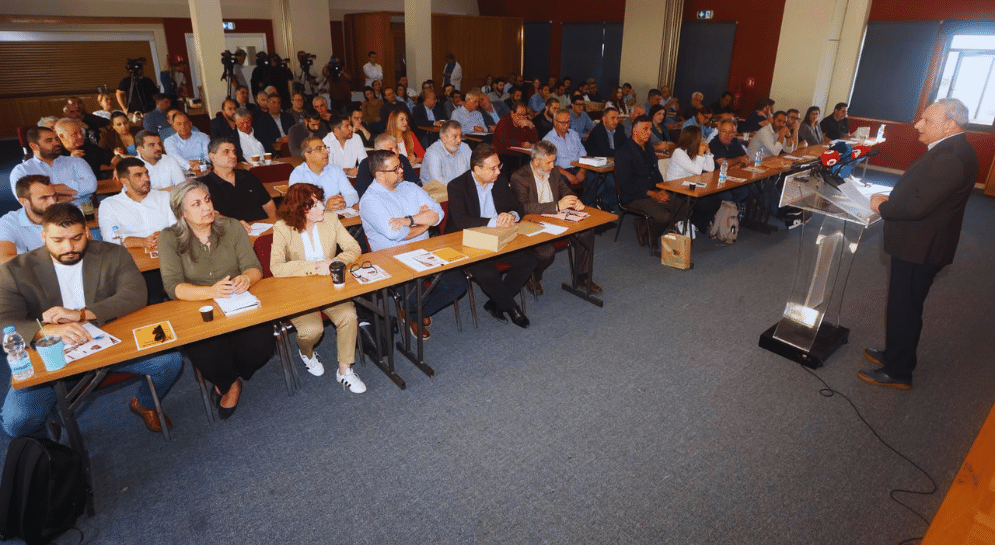
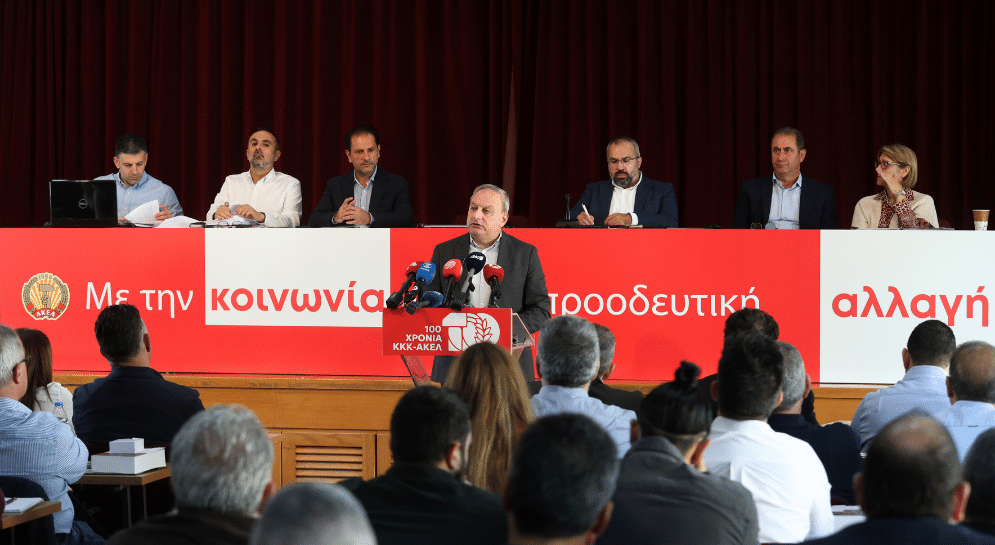
Speech by the General Secretary of AKEL, Stefanos Stefanou, to the Plenary Session of the Central Committee on the 2028 Presidential Elections
31 0ctober 2026, AKEL C.C. Press Office, Nicosia
Today’s plenary of the Central Committee has been convened to discuss and approve the political framework within which we will operate in the run-up to the Presidential Elections in February 2028. At the same time, however, we cannot overlook the historic milestone of our Party’s centenary. Not so that we immerse ourselves in sentimental reflections, but so that we might reflect on the weight of responsibility that this anniversary places upon our shoulders.
I am convinced that if these 100 years of history have taught us anything, it is from which side we should view the world. From the side of the left, of course, alongside the many, responding clearly to the great, timeless yet more relevant than ever dilemmas:
- With the majority of society or with the select, privileged group of powerful interests?
- With the rebellious youth of Europe or with the cold, accountant logic of Brussels?
- With international law or with à la carte sensitivities? The genocide in Gaza – and I shall not dwell on it – tests our consciences on a daily basis….
For 100 years – an entire century – we have chosen to view the world from the right side of history. This brings us to the decisions regarding the 2028 presidential elections.
For us, the elections have a profound political significance. They are not about personal ambitions or agendas, but about the opportunity to discuss the substance of the matter – everything that shapes our reality, both as a nation and as citizens.
The issue at stake is simple and clear: whose interests will the policies that the new government is called upon to implement serve?
Will it be those of the many or the few?
Those who have no voice and are invisible, or those who hold a privileged position in society and, behind the scenes, determine developments and circumstances?
In recent years, these questions have taken on even greater significance because, whilst the economy is growing and wealth is being generated, inequalities, economic insecurity and the risk of poverty continue to rise. This isnt merely confirmed by statistics. Most people experience it first-hand every day. They experience it when their wallet is already empty by the second week of the month and they wonder how they will make ends meet. They experience it when they cannot meet their family’s basic needs. Young couples face it when they are unable to start a family or even find a place to live. These are the very same problems plaguing Europe, and this is precisely why we are seeing such widespread social unrest.
The grim reality we are experiencing, in stark contrast to the prosperity suggested by the official figures, does not occur in a political vacuum. It stems from specific policy choices that were made and have led us to this point. Policies bearing the hallmark of DISY, starting with the haircut on deposits, which N. Anastasiades accepted, thereby breaking his most fundamental pre-election pledge and destroying thousands of households and small and medium-sized enterprises overnight. Citizens experienced the hardships of the period that subsequently followed first-hand, which is why I believe it is our duty not to permit political oblivion to prevail.
- ● For it was during this period that the Co-operative Bank was deliberately and consciously driven into bankruptcy and sold off to save a private bank.
- ● It was during this period that changes to legislation the way for the banks’ arbitrary power to steal people’s property and livelihoods through fast-track procedures.
- It was precisely then that European citizenship fell victim to a never-ending plunder that amassed an incredible fortune of billions in the hands of a handful of people who sent it to the Seychelles and other tax havens, whilst at the same time Cyprus’s reputation was being dragged through the mud internationally.
- It was then that institutions were being dismantled and manipulated to create a climate of confusion, cover-ups and impunity in an orgy of institutional entanglement, interwoven interests and corruption that prevailed in our country.
- It was during this period that scandals sprang up like mushrooms in major projects worth hundreds of millions, which were left half-finished and unused, because what mattered most to some was not serving the public interest, but the cut they would pocket.
- It was during this period that rights were deliberately and systematically undermined and labour relations were deregulated.
This is the Cyprus we have, unfortunately, been living in for the past few years. And those responsible for this dire situation have a name: they are the Anastasiades–DISY government and the Christodoulides government. For thirteen years now, their policies have been giving rise to and fuelling the unhealthy phenomena our people are experiencing. It is these policies they wish to continue, which is why they are publicly declaring their mutual support in the second round. In essence, DISY and the Christodoulides government are no different from one another. They are united by the same policies, and the only thing that divides them is personal ambition and expediency. Whether it is Christodoulides or DISY, in essence nothing changes.
Cyprus needs change. Progressive change that will serve the vast majority of our people. Change that will restore hope to common people. Change that will rid our country of entanglement and corruption. The policies that cause these problems must come to an end. Christodoulides and DISY must step down from power so that society can breathe again.
Some say, ‘These are valid observations, but do you have anything specific to propose?’ Our answer is clear: progressive change. Two words, with very specific meaning, which define the political framework on which we are called upon to decide today.
Comrades,
Friends of the Social Alliance,
It is easy to go it alone, putting forward positions and proposals that resonate with the sentiments of our narrow party audience. The difficult thing – and this is what we shall do – is to seek alliances in order to forge a broad progressive front aimed at bringing about change.
For AKEL, this is nothing new. Our centenary is a good opportunity to remember that the common good has always been the guiding principle behind our decisions. This is written into our political DNA, so on the path to progressive change we regard cooperation with other forces as the only way forward.
Such cooperation must, however, be based on a common ground, which will include shared positions and common goals on a number of key issues. This is our choice, and we are aware that it does not satisfy the need for sensational headlines.
We prioritise the political framework with persistence and seriousness. This is what we will seek to do in the period ahead of us, by initiating consultations, discussions and contacts with political and social forces. We believe there is ample scope to achieve this shared understanding, which will also serve as the guarantee for progressive change. And, of course, at some point we will also turn to the discussion of the person who will lead and embody the progressive cooperation we are seeking to build.
What are the key issues which, as AKEL, we believe can form the framework for progressive change?
- The solution to the Cyprus problem. The country needs a President who is willing, capable and bold enough to take the necessary steps towards a solution, an end to the Turkish occupation and the reunification of our country and people. Given the critical stage the Cyprus problem has reached today, it is not enough to simply verbally declare support for a Bi-communal, Bi-zonal Federation with political equality, or to issue general statements in favour of resuming negotiations. What is crucial is to safeguard the entire negotiation acquis, to utilise the Guterres Framework to continue talks on the remaining issues and, at the same time, to take initiatives and put forward proposals that can make the solution to the Cyprus problem beneficial for all involved parties.
- Strengthening the welfare state and working people’s rights through a social agenda that will provide solutions to the major problems facing Cypriot society: the high cost of living, inequalities, the housing and energy crises, labour market deregulation, the massive shortcomings in social infrastructure for modern families and the vulnerable groups of the population, the impoverishment of the elderly, and so much more.
- The defence of democracy against fascism and the far right is also a central pillar of progressive change. The prospect of the far-right ELAM party officially joining the country’s government is now a real possibility. Such a development would lead to new manifestations of authoritarianism and violence, threaten the democratic freedoms of our people, target social groups, and intensify nationalism, racism, anti-communism and the hatred they foster against the Left, whilst the distortion of our country’s history will be normalised. The progressive forces of our country have a historic duty to work together to isolate the far right.
- The introduction of a new economic model for Cyprus that will guarantee sustainable development and safeguard the environment and the country’s national wealth for future generations. Modern, effective and progressive proposals on issues such as energy, water, waste management, environmental protection and transport are key aspects of this new model of sustainable development for our country.
- The protection of strategic infrastructure, vital services – such as the health and education sectors – and the country’s wealth from being sold off en masse to foreign capital and hedge funds. The government that will bring about progressive change in 2028 will implement drastic and effective measures to protect our people’s quality of life, our public and natural wealth, and our country’s national security.
- The restoration of the rule of law and of our institutions, as well as the eradication of institutional entanglement, corruption and nepotism, are also part of progressive change. Progressive change means a new ethos and style of governance, with independent institutions and effective accountability, with zero tolerance for corruption, and with a President and government that confront entanglement rather than harbouring it.
- Progressive change and governance also require a different approach to our country’s international role and foreign policy. Instead of the current doctrine of subservience to the governments of Israel and the US and of serving their interests, the government of progressive change, whilst of course taking into account the fact that we are an EU member state, will pursue a multidimensional foreign policy. A policy that will be grounded in international law and peace, will ensure that Cyprus is not drawn into the militarisation and conflicts of the region, and will promote the interests of our people, with the top priority being securing international support for the struggle to end the Turkish occupation and resolve the Cyprus problem.
Comrades,
Friends of the Social Alliance,
I began my speech by referring to the 100th anniversary of the AKEL Communist Party of Cyprus, and so I shall conclude in the same vein. Not only to express our pride in all that we have achieved and all that we have won for Cyprus and our people, but because the culmination of this long political journey is the realisation of our historical responsibility.
AKEL has never shied away from taking on responsibility to serve Cyprus and our people, making the most of every opportunity that allows us to do so, including the presidency of the state. This is what it has done in the past, and this is what it will continue to do in the future, starting with the upcoming presidential elections.
This is how we turn history into the future.
This is how we build the future today.