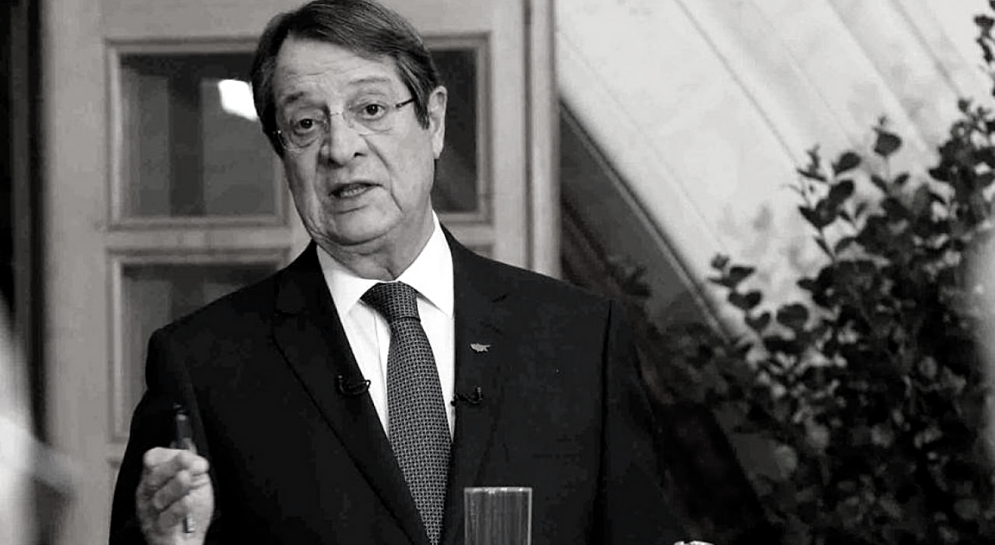

Speech by Giorgos Koukoumas, member of the Political Bureau of the C.C. of AKEL
AKEL event on the 1917 Great October Socialist Revolution
Friday 7 November 2025, Nicosia
“I too felt my little heart crying out like the vastness of Russia. I vowed to bring unity to my life, to free myself from a thousand forms of slavery, to overcome fear and falsehoods, to help others free themselves from fear and untruths. That I would no longer tolerate people committing injustice, that I vowed that we would give all the children of the earth clean air, toys, and letters, we would give women freedom and sweetness, and men kindness and gentleness. And a grain of wheat in the rustling heart of people.
“This is the voice of Russia,” I said, and I swore to follow it until death.
Oaths of a lover, I spoke the truth, I was determined to give my life. For the first time, I understood the joy felt by those who are stoned, burned, and crucified for an Idea. What fraternity/comradeship means, what it means that we are all one, I experienced it so deeply for the first time. And I felt that there is a good more advanced than life and a force that conquers death.”
These were the words of (renowned Greek writer) Nikos Kazantzakis when he was in Red Square for the celebrations of the 10th anniversary of the October Revolution.
And with these words, we welcome you all to tonight’s AKEL event in honor of the Great October Socialist Revolution.
The Revolution that shook the world and changed the history of modern humanity forever.
A Revolution that, in the course of history, took up the baton from the great uprisings of slaves and peasants carried out in the Middle Ages, from the two great bourgeois revolutions of the 18th century — the French and American revolutions —but at the same time, it was a qualitative leap forward, since it was a revolution that did not simply seek to replace one ruling class with another, but to abolish class exploitation itself.
Forty-six years after the heroic Paris Commune — the storming of heaven that was drowned in blood — the workers of a country, this time Russia — demanded not only a better life but also to take their rightful place at the forefront of history, and opening up — once and for all — the way for humanity’s historic transition “from the realm of necessity to the realm of freedom.”
Comrades,
Friends,
Some people wonder — sometimes mockingly — why we insist on honoring the Socialist Revolution of 1917, an event that took place more than 100 years ago, especially since the state that gave birth to it — the Soviet Union — ceased to exist 35 years ago. To answer this sophistry, we must first clarify —but also fully understand ourselves — that for us, the October Revolution and its legacy are not nostalgia and souvenirs of a charming past, but a solid foundation of our history and ideology that permits us to look ahead, high and clear.
The first reason, then, why we honor — and will continue to honor — the October Revolution is precisely because we insist on believing in a radically different world, in a society that is just from its very foundations, believing in socialism. In other words, believing in a society that is not just a little better, with a somewhat more tolerable life, but a society where everyone has a home, food, education, health, and culture will not be the goal of any government — in the best case scenario — but the guaranteed reality of the entire organization and functioning of the economy and the state, and all this will be as self-evident as the rising of the sun.
We believe in a society without class exploitation, because the keys to the economy will not be held by a handful of big businessmen and wealthy magnates, but by the working people themselves who, with their minds and hands, drive the wheels of the economy.
We are committed to the dawn of this world and continue on the path of an international movement that, since the beginning of the 20th century, millions of people have believed in, fought for, and have sacrificed their lives for when necessary, without ever saying that fate has wronged them, but quite the opposite.
Our belief in this future defines us both ideologically and morally. It defines us collectively and individually. It defines us now and always.
We therefore honor the October Revolution because it proved that this world is not only just and necessary, but also achievable.
Because we dare to dream and envision, with visions that transcend the limits of today and the system.
Because we dare to link the struggle for our homeland and our demands for workers, education, health, welfare— that is, the struggles for today — with the vision for tomorrow, the socialist tomorrow of our country and the whole world.
The second reason why we honor— and shall continue to honor —the anniversary of the October Revolution is because the causes that ignited the fires of October continue to exist. And as long as these causes exist, people, the peoples, nations, societies, and the classes that suffer exploitation and oppression will seek a way out. In fact, these causes not only exist, but have become more relentless, more suffocating, and more explosive, inevitably raising the question of what future we are heading towards and what future we want.
Can anyone really convince us that the ‘end of history’ is a world where the richest 1% of the planet owns half of the planet’s wealth, with power and influence that is now greater than that of entire states and nations?
Can we indeed accept that the fate of our generation and that of future generations is a world where 3.5 billion people live below the poverty line whilst, at the same time, over the next 2-3 years, for the first time in the history of our planet, the class of extremely rich trillionaires and magnates will emerge?
Can we one wonders accept that economic growth really means that every year three million workers around the world lose their lives on the job, in accidents and from occupational diseases, in other words, an all year-round human holocaust of the global working class committed for the sake of serving capitalism’s economy?
The stand “No, we don’t accept it” is — at least for most people —the obvious answer. But it is only half the answer. The other half lies in the realization and awareness that all these appalling inequalities, the frenzied rampant accumulation of wealth, the poverty, and destitution cannot obviously be perceived as misfortunes of life, nor are they simply the result of misguided economic policies, but rather a reflection of capitalism itself. Even the most developed countries cannot escape cyclical crises, inequalities, unemployment, and the deterioration of working and living conditions.
At the heart of this turbulent world lies the inherent contradiction of the system itself: on the one hand, labour and production have been socialized on an unprecedented scale worldwide, but on the other hand, the lion’s share of wealth is reaped by a minority class which, in fact, is now less and less involved in the management and organization of businesses, but simply reaps the profits of its shares in business groups, banks, industries, and digital tech giants.
These explosive contradictions and inequalities also affect our country, despite the size and particular characteristics of the Cyprus economy. One need only consider two seemingly unrelated recent news items.
The first is a Eurostat survey that revealed that Cyprus had the second highest percentage in the European Union of working people working more than 49 hours per week.
The other is a BestBrokers survey from the United Nations World Inequality Database, which found that Cyprus ranked first among 217 countries in terms of wealth concentration.
In 20 years, the richest 1% of Cypriots tripled their share of the country’s wealth. Twenty years ago, the richest 10% of Cypriots owned half of the country’s wealth, while now they own two-thirds of the wealth and the remaining 90% of our people share what is left.
All this testifies to the dead ends and incurable contradictions of capitalism, in all its forms and manifestations. It is therefore an objective reality — and not our obsession or “ideological fixation” as we are often accused of — that time and time poses the challenge so vividly expressed by Engels: “socialism or barbarism.”
The third reason we honor and will continue to honor the October Revolution is because its very conception, contribution and development encapsulate an inspiration of boldness and dialectics in theory and practice that remains valuable and, to this day, irreplaceable for the international communist and left movement. Through the analysis of the pre-revolutionary social and political conditions and the rapid sequence of historical developments in 1917, we stand and uphold certain timeless principles that serve as a compass for the Communist and Workers’ parties.
The October Revolution demonstrated, for example, the importance of revolutionary theory, with Lenin himself with his monumental works contributing to the development of revolutionary but of universal thought as well, while at the same time being at the forefront of waging the ideological struggle to clarify philosophical, theoretical, and strategic issues concerning the world, the state, political action, the Party and its character, and the revolutionary perspective.
Lenin’s emblematic work on imperialism, as the development of capitalism in its monopoly stage, showed how the contradictions fuelled by the uneven development of imperialist countries create weak links in the chain of the global system where, under certain conditions, a socialist revolution can break out. His analysis of the nature of imperialism — whether militarily, through force or not — of monopolies and the redivision of the earth, has not only lost none of its relevance in the 21st century, but has multiplied it, at a time when the European Union is arming itself to participate from a better position in the ongoing inter-imperialist rivalries, while Trump — without any diplomatic niceties — bluntly demands the surrender of Ukraine’s mineral wealth, the annexation of Greenland, whilst unleashing trade wars against everyone.
Scientific theoretical knowledge was and remains a great weapon of the communist movement in the analysis of today’s phenomena. And although Lenin attached great importance to ideological education and self-education, this — let us not forget — is primarily an ongoing responsibility that communists and their Party impose on themselves in order to broaden and deepen our thinking and action. It is not a reason to retreat introvertedly into our shells or engage in discussions that sometimes resemble the theological debates of the Middle Ages about the gender of angels.
On the contrary, the October Revolution and the Bolsheviks put into practice the principle that the consciousness and trust of the people are won in the arena of action fighting for the immediate needs and demands of the people.
The Bolshevik Party achieved this in a spectacular manner during the period between the two Revolutions of 1917, in February and October. Through their action in the Soviets of workers, soldiers, and peasants, through their daily work on the front lines and at the rear, through their struggles in factories, in cities and villages, they captured the pulse of the people and the Bolsheviks. Thus, from a small group, they became the majority by the summer.
This is what Lenin characteristically wrote on the revolutionary vanguard party that it must “connect, approach, and to a certain extent merge with the broadest masses of workers, with the proletariat, but also with the non-proletarian working masses.”
It is precisely there, in the arena of waging daily struggles for wages and living standards, where working people see communists alongside them, that the people themselves understand who is with them and who is against them.
And of course, the crucial thing is the answers communists project to the questions posed by the given era and the people so that the revolutionary party can move forward. The October Revolution was the Bolsheviks’ answer to the questions posed by their own era and the issues that were then tormenting the Russian people, such as the endless slaughter of World War I, the land question, the unresolved national issues within Tsarist Russia, mass poverty, and destitution. The Bolsheviks responded to these issues not with generalities but by elaborating and putting forth programmatic demands — peace, power to the Soviets, land to the people —which could be achieved through the Revolution, as indeed happened from the very beginning with the announcement of the corresponding historical decrees.
At the same time, the course and experience of the Revolution highlights the depth and wisdom of Leninist dialectics in terms of the tactical manoeuvres, compromises, and formation of alliances that are necessary at any given moment in the crucible of real life and struggle. Life is much more complex than theory and books. Even more so when this concerns a Revolution.
The developments from February 1917, when Tsarism was overthrown, until October highlight the ability of the Bolsheviks — and certainly of Lenin — to formulate revolutionary policy that can distinguish the primary essence and the crucial from the secondary, that can distinguish the acceptable from any unacceptable compromises, in order for the revolutionary course of the Party to move forward towards fulfilling its goals.
The Bolsheviks’ stance towards the coup d’état by the extreme pro-monarchist right wing led by General Kornilov, which in the summer of 1917 threatened to end the bourgeois-democratic revolution that had overthrown the Tsarist dynasty of the Romanovs is a prime example of such ability. The Bolsheviks did not waver, they did not remain indifferent to Kornilov’s rebellion. On the contrary, they rallied the people against the coup in order to save the revolution from the greatest danger threatening it, even if this could apparently give a breath of life to Kerensky’s provisional government, a government that had already turned fiercely against the Soviets and the Bolsheviks themselves. Developments confirmed the tactic, as not only was the coup crushed, but the reactionary nature of Kerensky’s government was revealed, while the leading role of the Bolsheviks in the resistance broadened their appeal and accelerated the path to the October Revolution.
Of course, the greatest legacy of the October Revolution and the socialist project in the Soviet Union was the proof that it is indeed possible to build a state and a society that eliminates unemployment, poverty, and illiteracy.
That it is possible to build a state that guarantees permanent and stable employment for all, with a 5-day, 7-hour working week since 1950, a state that guarantees housing, pensions, social welfare, free education and healthcare, access to culture and sports, that provides comprehensive support for motherhood, the right to holidays and leisure time.
A state that would turn the country into an ocean of universities and cultural institutions, libraries, museums, theatres, conservatories, cinemas, exhibition spaces, stadiums, and gyms that would be open to literally everyone.
That a state can be built that truly turns the page of history on gender equality, pioneering technology and space exploration, and stands in solidarity with the world’s national liberation and anti-colonial movements.
The greatest contribution of this state — the Soviet Union — was and will remain rescuing humanity and human civilization from the evil darkness of Hitlerism. With the blood shed and the sacrifices made by tens of millions of people of the Soviet Union and under the leadership of the Communist Party of the Soviet Union, it was possible to crush Nazism in World War II and ensure the end of the Holocaust, concentration camps, crematoria, and mass Nazi exterminations in the occupied countries.
For this contribution of the Soviet Union to humanity alone, no democratic person should accept anti-communism, the revision of history, or the equation of fascism with communism. All the more so since we all know – and it is evident today, in the era of Meloni, Trump, Orbán, and domestic fascists, etc. – that nine times out of ten, fascism appears first as anti-communism.
Permit me here to digress briefly on the corresponding historical distortion that has been taking place in recent years in our country concerning the role of the Soviet Union in relation to the Cyprus problem. Although the issue is not history and its interpretation, but rather the attempt to convince the Cypriot people to love their rapist and accept Cyprus’s accession to NATO, let us examine what they are saying.
Alongside the far-right columnists, we now also note the so-called liberals, who they all agree on the theory that the Soviet Union is responsible for creating and perpetuating the Cyprus problem, as it is claimed that the Soviet Union supposedly prevented a solution to the Cyprus problem in order to perpetuate the confrontation between Greece and Turkey. Of course, what they mean is that the Soviet Union stood by the Cypriot people and their leadership against the plans to partition our country and create a “double enosis,” , as were the solutions being elaborated and hatched in NATO, as well as the attempts to remove the Cyprus problem from the framework of the UN.
The propaganda reaches the limits of absurdity when one considers that what they are claiming can be summarized as follows: Even though the colonizers were NATO, members even though the guarantor powers and bases are NATO, even though the coup plotters and invaders belonged to NATO, even though the occupying power is a NATO power, even though those who have been arming the occupying force for decades belong to NATO, the culprit of the Cyprus tragedy, they claim, is not NATO itself but instead the Soviet Union.
The reality is that Cyprus had the political, economic, commercial, and, of course, diplomatic support from the Soviet Union, which was always consistent and steadfast, in all the international forums, and especially in the UN, in the struggle to rid our country of all foreign troops and reunify our homeland. Let us remember that the United Nations Resolutions that protect the Republic of Cyprus and its existence to this day have been achieved with the decisive support of the Soviet Union, the socialist states, and the Non-Aligned Movement.
Dear comrades,
Dear Friends,
When talking about the achievements and contributions of the state that was born out of the October Revolution, the question inevitably arises as to how we — the modern communist Left —should address the mistakes, distortions and crimes that were committed in the course of socialist construction and the bitter end of the dissolution of the Soviet Union and the socialist community.
The answer is: with the truth. We must acknowledge without any hesitation — not, of course, the anti-communist propaganda — but the truth, the whole truth, and nothing but the truth. Because those of us who truly believe that socialism is something that concerns the future have a double responsibility to acknowledge — as a movement —the mistakes that were committed so that they are not repeated and that the same outcome and defeat is not repeated.
Of course, none of this proves that socialism cannot be implemented and that it is doomed to collapse. The exact opposite is true. The socialist camp flourished as long as its course was in line with the ideals, goals, and principles of the Socialist Revolution. The main reason for the mistakes committed and ultimately the defeat suffered must be sought not in socialism and communist values, but precisely in the deviation from them and their distortion, which was brought about by the Soviet and party leadership itself.
Comrades,
Friends,
The Red October of 1917 shook not only Russia but the whole world with a revolutionary shockwave. Our own Party is also a fruit of the October Revolution, whose messages resonated with the reality of the Cypriot poor and the impoverished peasantry.
Since its foundation, our Party, first as the Communist Party of Cyprus and later as AKEL, it did not renounce its ideology nor its vision of socialist transformation, no matter what the repression it suffered, and no matter where these attacks on it came from.
It did not renounce its ideology even in the face of the persecutions, imprisonments, prohibitions and the murders that were committed.
It did not renounce its ideology even when the Soviet flag was being lowered from the Kremlin, during the times of global upheaval, of widespread slander and general confusion.
Quite the opposite occurred, throughout this century — ever since the pioneering communists of Cyprus planted the seeds of communist ideals and the socialist vision in the working class and the working people of Cyprus in general — our Party has been guided by this vision. As a robust and serious force of principles and a vision that fights for today and looks to the future, to building a society and a world that is fundamentally just and peaceful, free from all forms of exploitation: a society and world of socialism. A vision that we do not serve as a slogan or as a candle that we light every night. But with a strategy, policy, and tactics that respond to our times and our country, just as our ideology dictates.
And that is precisely why our Party has determined for decades that a necessary prerequisite for setting the goal of socialist transformation of Cypriot society is our homeland’s liberation from the foreign occupation so that the Cypriot people, Greek Cypriots and Turkish Cypriots. The vision of socialism in Cyprus can only be a goal that concerns the entire Cypriot people and the entire island. The solution of the Cyprus problem on the basis of principles and the agreed framework is what will permit the organisation and waging of common class struggles on the island, which were violently and bloodily interrupted by ongoing imperialist interventions, the occupation, and nationalism, to resume.
For this reason, the Left in Cyprus has been and will continue to be at the forefront of the struggle for freedom and the reunification of our homeland, in the struggle for a solution to the Cyprus problem, and for this reason we boldly and consistently insist on the line that can break the current deadlock. For a free, independent, and united homeland. One that will belong to its people and will be a bridge of peace in the Eastern Mediterranean, not a parking lot for American, Israeli, Turkish, or any other foreign armies.
With this vision — the vision of socialism, peace, and democracy — and with this strategy — the strategy of AKEL that has been embraced by our people throughout history — we continue to march forward and engage in political struggle today.
For workers’ rights, for collective agreements, the minimum wage, and the extension of the Automatic Cost of Living Allowance.
For the right of the young generation to housing and to put a stop to the mass sell-off of our land.
For free education and healthcare.
For everything our people deserve. Because this homeland does not belong to the bankers, big developers, and big businessmen, whom we have seen in the last 24 hours provoking the whole of society with their arrogance.
This country was established and built by working people, and the economy’s driving force is the people who either work as employees in a company office or at home behind a computer, or who work in factories and on construction sites, or in classrooms and hospitals. In any case, they work and live through their own efforts and not by the efforts of others.
And there is no better force in the world that we want to represent, and there is no better honor — in our visions, ideology, and history, in the sacrifices of our pioneering comrades — than to ensure an AKEL that is strong everywhere and always. In the ongoing struggles, in the movements, at the workplaces and educational institutions, in neighborhoods and districts, in Parliament and in the municipalities, in the digital world, everywhere.
And it is to this task that we — the current generation of AKEL members —are called upon to respond. And it is on this task that we will be judged.
Comrades,
I come back to the anniversary, for perhaps there is no other milestone in human history that has been so reviled and fought against as the October Revolution. As an idea, as a meaning, as a message, as an example.
Even also in the face of the contemporary polemic that, since 1990, has rushed to proclaim the end of history and ideologies, even if history has made it clear that we are finished and that the “orators” of revolutionary change should shut up, all it takes is a quick glance at the history books to see the real development of History.
All it takes is to take a glance in the pages about Spartacus or our own (revolutionary Medieval peasant uprising leader) Re Alexi, the French Revolution or Mandela, the suffragettes or Worker’s May Day in Chicago, all of which were once declared “errors in the chapter of the wrong entry.” And then those who do not want to lose heart will be convinced that the battles are always ahead of us and waiting.
This is precisely what those who claim the title of communist must keep in mind. That — slower than we would like, but sooner than we think —the dawn of human history will rise, when it will be as natural as the rising of the sun for everyone to have what they deserve and need.
That, in the end, for a ship to set sail, it needs sailors, it needs engineers, it needs captains, but it does not need shipowners. And then, everything will shine differently…
Just as the October Revolution was and remains a sparkle, a flame on the historical horizon that has been shining since 1917 into the 21st century.
ETERNAL HONOR TO THE GREAT OCTOBER SOCIALIST REVOLUTION!
LONG LIVE SOCIALISM!
LONG LIVE AKEL!