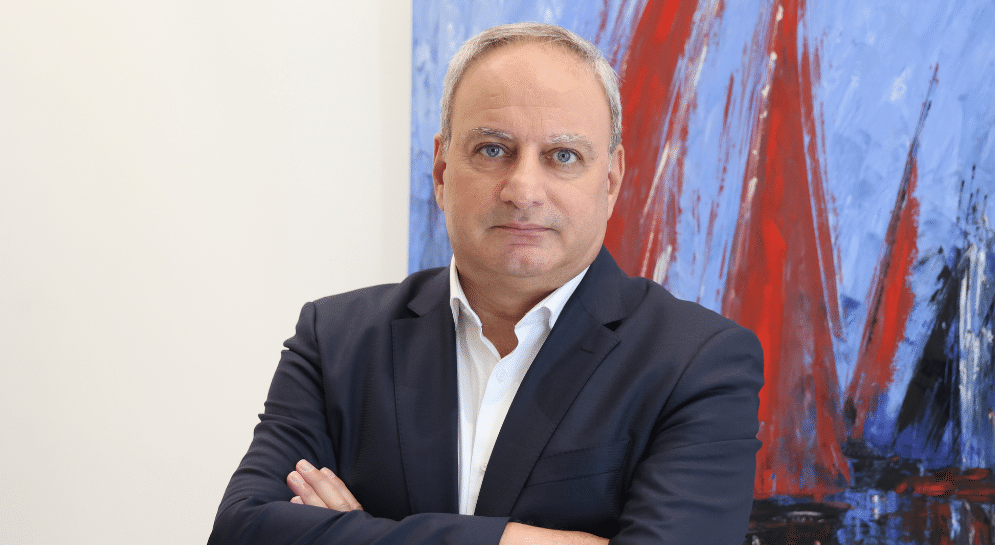
Interview with the General Secretary of AKEL Stefanos Stefanou
Sunday 27 September 2026, HARAVGI newspaper
- Cyprus needs a change of course
- AKEL and the political leadership are unaware of Christodoulides’ “new ideas” on the Cyprus problem
“We cannot tie Cyprus’s fate to that of any other state, based on logic such as “the enemy of my enemy is my friend”
“When we seek support against Turkey’s policies, how can we be convincing when the Cypriot government turns a blind eye to Israel’s illegal actions?”
“The welfare state has suffered serious blows in recent years under right-wing governance”
“We rule out candidates who seek to continue policies with which we disagree with and which are causing turmoil in Cypriot society”
—————-
QUESTION: On Tuesday evening, we saw and heard Recep Tayyip Erdoğan calling on the international community to recognise the [illegal regime in the] occupied territories. How do you respond to that?
SS: Turkey’s position – which has been officially stated since the collapse of the Crans-Montana procedure – regarding the recognition of two states in Cyprus – is unacceptable. It runs counter to the resolutions and decisions oof the United Nations, it flagrantly violates international law and, of course, it cannot and will not be accepted.
At the same time, of course, we must bear in mind that the passage of time reinforces the partitionist fait accomplis resulting from the occupation, both on the ground and in people’s minds. For this reason, regardless of the difficulties provoked by Turkey’s intransigence, we must continue our efforts to create the preconditions for breaking the deadlock and resuming negotiations from the point at which they were suspended in 2017.
QUESTION: So far, however, despite the developments mentioned by the President of the Republic, things do not seem to be moving forward. On the other hand, the President is constantly referring to “new ideas” which he has submitted to the UN Secretary-General. Are you aware of their content?
SS: No, we are not aware of what these proposals contain. We do not know exactly what he is proposing or what he is doing. It is the President’s duty to brief us.
The President of the Republic, through his statements, had raised excessive expectations regarding the UN Secretary-General’s new initiative. The President had spoken of plans for a solution and various other developments, which subsequently proved to be unfounded.
From the very outset, it was clear that the UN Secretary-General linked the launch of a new initiative to the creation of the necessary and tangible preconditions that could ensure its successful outcome. In his view, this success would have to be achieved by breaking the deadlock surrounding the Cyprus problem and resuming negotiations through an informal, expanded meeting, which he wanted – and still wants – to convene.
However, the Secretary General believes that the necessary conditions are not yet in place. He has also made it clear that he will not convene a new meeting simply to discuss Confidence Building Measures, as was the case in previous meetings, but the continuation of the negotiations to be agreed upon.
“The enemy of my enemy is not my friend”
QUESTION: Political analysts and international relations experts, mainly from Greece, argue that Cyprus’s rapprochement with Israel does not help the cause of the solution of the Cyprus problem, particularly under the current conditions. What is your position on this? Are you opposed to the development of relations with Israel?
SS: First of all, the term ‘rapprochement’ with Israel does not, in our view, accurately reflect what is actually going on. The Christodoulides government’s foreign policy is effectively turning Cyprus into a pawn of the policies, objectives and strategic aims of the Netanyahu government’s foreign policy.
At the same time, the fact that the government does not denounce, condemn or comment on the ongoing genocide being committed by Israel against the Palestinians, nor on its aggressive policy in the wider region, strips us of our political and moral standing on the international stage.
When we seek to draw support against Turkey’s policy – which violates international law through its illegal occupation and colonisation policies in Cyprus – how can we be convincing when the Cypriot government turns a blind eye to Israel’s illegal actions?
We, for that reason, disagree with this particular government policy. Our foreign policy must be characterised by a balanced policy and be based on and serve international law and, at the same time, it must be mutually beneficial.
We cannot tie Cyprus’s fate to that of any other state, based on logics such as “the enemy of my enemy is my friend”.
Nor should any false hopes and illusions be cultivated within Cypriot society – as the government is actually doing – that, to a greater or lesser extent, Israel will supposedly come to our defence against Turkey. The way the government is handling matters is making us a target and turning Cyprus into an arena of fierce and dangerous confrontation between Turkey and Israel.
QUESTION: Do all these developments not also affect the effort to solve the Cyprus problem? At a time when you are seeking talks with Turkey, Cyprus is proceeding to conclude agreements with what is perhaps its main rival in the region today. Do you think this will have an impact?
SS: Our foreign policy must also serve the aim of resolving the Cyprus problem. This, of course, does not mean that we are nullifying or abandoning our sovereign rights.
We must handle all of these issues with care. On the one hand, we must underline our state’s sovereignty and protect its rights; on the other, we must also serve the objectives we have set ourselves, first and foremost the solution to the Cyprus problem. In our view, even at this level, the government is not pursuing a policy that is being carefully pursued based on these objective goals.
On expensiveness, fuel prices and the high cost of living
QUESTION: Let’s move on to the economy. We are seeing price rises for essential goods, whilst fuel prices have soared and look set to rise even further. What needs to be done, given that the government is announcing measures which, however, do not serve the purpose for which they are announced?
SS: First and foremost, the government must acknowledge that there are serious problems, which are being exacerbated by the cost of energy and fuel.
To date, it appears not to have adequately recognised either the problem or the need to take specific measures that will have an immediate impact. Furthermore, the government is neither, nor implementing policies which, in the medium and long term, will protect Cyprus and its citizens as far as possible, in relation to both the economy and the cost of living.
The recent statements by the Minister of Finance are telling. He says that ‘if new measures are needed, they will be considered’. Of course they are needed.
Firstly, because energy is a vital and decisive part of the economy. The more energy costs rise, the greater the burden on the economy, society and households.
Secondly, fuel prices have skyrocketed. One might argue that this is partly due to the rise in international prices. Fair enough! There is, however, one issue: when international prices fall, the reduction is not reflected in Cyprus to the same extent in fuel prices. Conversely, when international prices rise, the increases are passed on very quickly to prices in Cyprus.
To put it simply, prices rise quickly and fall very slowly and with a time lag.
This places an additional burden on society. Measures with immediate effect are therefore needed, particularly given that Cypriot consumers do not have the same choices in communication and public transport as citizens of other European countries. Given the way our daily lives have developed over recent decades, a Cypriot household needs two cars to meet its needs.
The government must abandon the policy whereby it increases its revenue through high prices but, at the same time, fails to give enough of this increased revenue back to society to enable citizens to cope with the difficulties.
On the upgrades of the economy and social inequalities
QUESTION: This also raises the issue of the upgrades of the Cyprus economy by credit rating agencies. The government is celebrating that the economy is doing well because the credit rating agencies are giving Cyprus a positive assessment. How is this reflected in people’s everyday lives?
SS: The problem is that it is not adequately reflected in people’s daily lives.
Inequalities are growing, the cost of living is rising, at the same time as people’s incomes are neither rising, nor keeping pace to the same extent. The wealth generated is increasingly concentrated in fewer hands, whilst the risk of poverty is rising for larger sections of society.
In our view, this is no accident. The welfare state has suffered serious setbacks in recent years under right-wing governments. The necessary redistribution of generated wealth is not taking place through the state policies being implemented and the regulation of labour relations, so as to provide support to the lower and middle strata of society.
Even the so-called tax reform being promoted by the government, with the support of the parliamentary majority, we believe favours the higher income groups and the wealthy rather than the lower and middle strata who are most in need, as we maintain.
Policies providing substantive support for society are also needed. The economy’s recovery is certainly a positive development, but the government cannot use this as a smokescreen to hide the structural problems of the Cypriot economy and fail to address the challenges facing it.
These problems require specific, comprehensive policies, infrastructures and measures. Otherwise, we remain exposed and vulnerable to international and regional developments. We saw this when a drone crashed at the British Bases, resulting in a major blow being dealt to tourism.
On the pension reform
QUESTION: At the same time, the debate on pension reform is also under way. From what we have seen so far, high expectations have been raised, but the outcome may not be as anticipated. How does AKEL view this?
SS: Indeed, the government has, in this case too, raised excessive expectations. Its proposal does not satisfy or meet those expectations.
It is absolutely essential that any pension reform ensures pensioners an income that will enable them to meet their living costs and enjoy a dignified standard of living. In our view, this is not achieved by the proposal currently before us.
There is a sense that the government is merely attempting to redistribute the existing “pie”. However, problems cannot be addressed in this way. We need a greater contribution from the state and policies that will secure more resources. The approach must be holistic and comprehensive.
It is not enough simply to improve pensions from the Social Insurance Fund, Pillar One, however important that may be. That system is contributory: you get back what you put in.
Of course, we must simultaneously ensure the sustainability of the Social Insurance Fund and create prospects for increasing its revenue, so that it can offer more to pensioners. This is also linked to the gradual repayment of the state’s debt to the Fund. We must also examine the Fund’s investment policy so that a genuine reserve can be built up.
Secondly, we must look at the so-called “pillar zero”, that is, the state’s social policies and measures concerning pensioners, as well as other sections of the population. The state must meet specific needs, for which pensioners are currently forced to spend part of their limited income or, in many cases, are unable to meet them at all.
Thirdly, we must examine the situation regarding Provident Funds. This scheme must be extended to cover all working people, through collective agreements and specific measures.
As part of the pension reform, existing problems must also be addressed, such as the 12 per cent actuarial reduction and the issue of the widow’s pension for men who lost their wives before 2018. These issues must be resolved through the reform. Unfortunately, the government’s proposal is not satisfactory in this regard either.
On the 2028 Presidential Elections
QUESTION: Let’s● ter move on to the Presidential Elections. Without realising it, we have gradually entered an informal pre-election period. How is AKEL proceeding on the matter?
SS: AKEL is proceeding in accordance with its own procedures. We will work to achieve a broader consensus and cooperation, with the aim of creating a majority for progressive change in the country, which will be expressed through a candidacy in the Presidential Elections.
This cooperation and rallying of forces must be based on common ground regarding the fundamental issues that determine the course of the country and its people.
In the period ahead of us, alongside its internal party procedures, AKEL will begin a series of meetings, soundings and discussions to explore the scope and possibilities for such cooperation and consensus.
Along the way, we will also discuss the question of the candidate: who could best represent this broader effort by progressive forces in the run-up to the 2028 elections, so as to bring about change in the country.
QUESTION: So you have not ruled out either an AKEL candidate or a possible candidacy by the General Secretary of the Party?
SS: We have ruled out candidacies that do not prioritise the solution of the Cyprus problem on the basis of the agreed form of a solution and the objectives that exist today: to break the deadlock surrounding the Cyprus problem and resume negotiations from the point at which they were suspended, whilst safeguarding the negotiation acquis. Secondly, we rule out candidates who seek to continue policies with which we disagree with and which divide Cypriot society.
We also rule out any discussion of supporting any candidate whom there are various doubts about or who fails to recognise that there is a serious problem of institutional entanglement/interwoven interests and corruption in the country.
Beyond that, our options are open. We are not ruling out anyone, including a candidate from AKEL. However, these matters will be discussed in due course, taking into account both convergences on policies and the qualities we believe a winning candidate must possess.
QUESTION: Based on what you have described, are there currently any political forces that meet these criteria, such that cooperation with them might be possible?
SS: There are political forces that position themselves in opposition and disagree with the policies being applied by the current government. This, as you will appreciate, creates an objective basis for seeking consensus and forging cooperation.
However, if we do not engage in the discussion, we cannot predetermine its outcome. There is a range of possibilities, which we will endeavour to utilise and nurture.
QUESTION: Some claim that AKEL has been slow to address the issue. In the past, of course, AKEL would begin focusing on the Presidential Elections five or six months before the vote, whereas now the process begins more than a year in advance. Do you agree that there has been a delay?
SS: You have, in fact, answered the question in your introduction. We started much earlier and are holding discussions much sooner than in previous election campaigns.
AKEL will take its decisions in good time, always in accordance with its statutory procedures. We will take our decisions in good time and launch our election campaign in good time.
“The party’s grassroots membership will play a key role”
QUESTION: Will the whole party be involved in this?
SS: Absolutely. After all, the involvement of the whole party and its supporters is a statutory obligation.
QUESTION: Will the priorities and conditions you mentioned be put to the party’s grassroots before or after the candidate is selected?
SS: Certainly before. The first discussion we will have with the party as a whole will concern how we approach the issue of the Presidential Elections: what the scope is, what our priorities are and what we will endeavour to do.
The entire framework of our approach and the work we will undertake will be discussed with the grassroots membership. We will listen to views and formulate this framework together, so that the grassroots party membership have a meaningful say.
Subsequently, in accordance with the prescribed party statutory procedures, we will involve the entire party in the decision-making process regarding the issue of supporting a candidate.
We must not forget that the party’s statutory procedures provide for the convening of a Pan-Cyprian Conference, which will decide by secret ballot who the candidate AKEL will support.