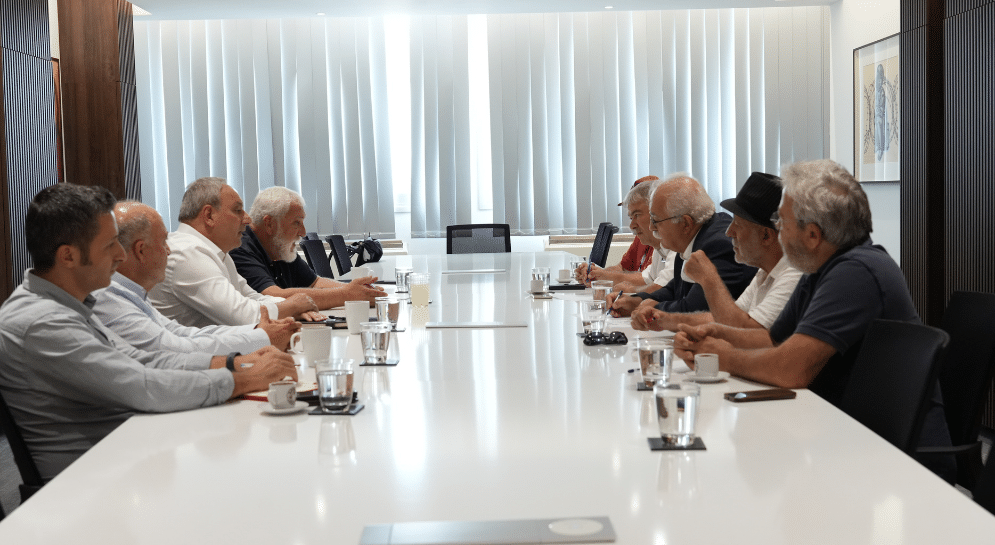
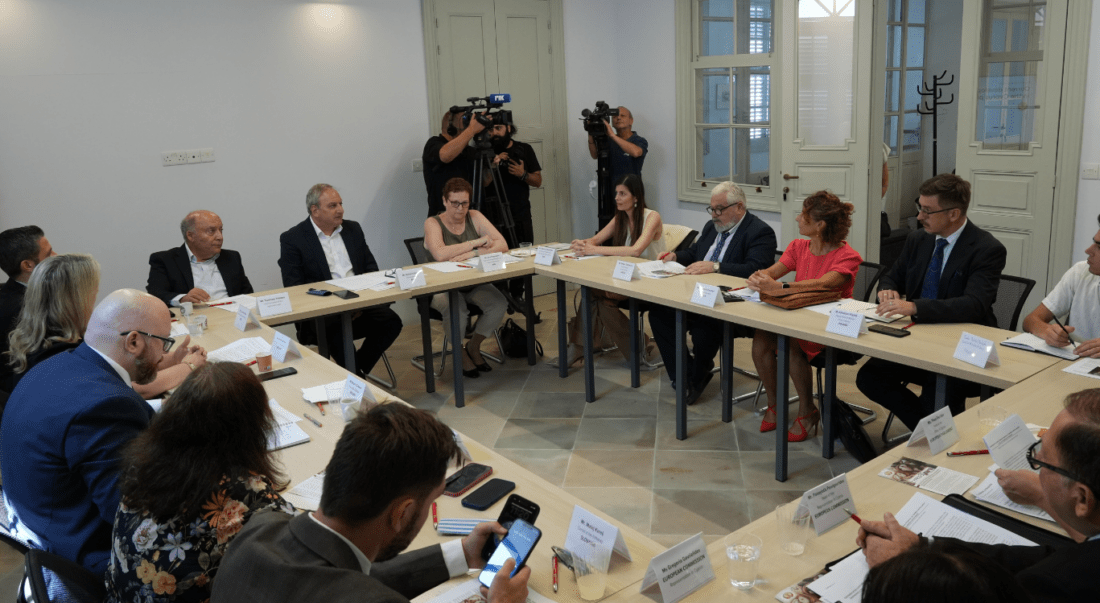
Meeting of the General Secretary of AKEL, Stefanos Stefanou, with Ambassadors of EU member states, on developments concerning the Cyprus problem
Wednesday 8 July 2026 Arsinoe Business Centre, Nicosia
On behalf of AKEL, I would like to thank you for accepting our invitation to meet with us today. We welcome the opportunity to brief you on our Party’s positions in light of the ongoing processes and the possible developments concerning the Cyprus issue.
Let me begin by making the following point: AKEL supports unreservedly the launch of a new initiative by the UN Secretary-General, Mr. António Guterres. The Secretary-General has an in-depth understanding of the Cyprus issue, he has devoted a lot of time in the direction of reaching a solution to the problem, and it was through his personal engagement that we came within a single mile of reaching a strategic agreement at Crans-Montana in 2017. If therefore, there is to be any substantive progress towards a solution in the coming period, this can be achieved through the initiative of Mr. Guterres, even if his term of office concludes at the end of the year.
For us, the solution is a matter of urgency. It is AKEL’s long-standing position that the passage of time worsens the prospects of achieving a solution, since the realities on the ground continue to entrench the completion of partition while, at the same time, a large part of society in both communities becomes accustomed to the status quo, which is unacceptable, but also dangerous for our country and our people. Fifty-two years have already passed since the catastrophic summer of 1974, when Turkey launched its illegal invasion and occupied a large part of the territory of the Republic of Cyprus, and sixty-two years since the intercommunal conflicts of 1964.
We currently are at a stage where the UN Secretary-General is exploring the possibility of convening an informal expanded meeting with the aim of breaking the deadlock and resuming the negotiations on the Cyprus problem. Mr. Guterres’ intention is to present an outline of positions that would serve as a general framework for the negotiations, along the lines of what he did at Crans-Montana with the Framework he presented at the time. This Framework covers the six core chapters of the Cyprus problem (four relating to its internal aspects and two to its external dimensions), in which Mr. Guterres incorporated the principal convergences that had been achieved, together with his own approaches on the issues that remained unresolved.
By pursuing a similar approach, the UN Secretary-General is obviously seeking to break the longest deadlock ever and to advance a process that is effective, results-oriented, and capable of being concluded in a short period of time.
Against this backdrop, and in order for the new effort to have prospects of success, it is imperative – in our opinion – to do the following:
- The negotiations should resume from the point where they were interrupted in 2017 and, consequently, the convergences – which are numerous and significant – should be preserved. I recall that, not coincidentally, this was the position of the UN Secretary-General for several years following the failure of the Conference at Crans-Montana. He knew—and this remains entirely valid today—that if convergences achieved through extensive work and effort are set aside, it will be extremely difficult to reach again an agreement. Particularly on fundamental issues.
- In order to overcome any possible disagreements of the two sides as to which are the convergences and the precise point at which the negotiations were interrupted, their recording should be undertaken by the United Nations. That is, to follow the same practice that was successfully applied in 2013 by the then UN Secretary-General’s Special Adviser, Mr. Downer. Otherwise, we are very much concerned that we will enter into another endless discussion over exactly where the negotiations were left off.
- The two sides should submit their views on the accuracy of the recording, which should be taken into consideration, after which the final list of convergences should be presented.
- Each side should be able to request amendments to the convergences, and, if these amendments are not accepted by the other side, the existing convergences should remain in force.
- The preservation of the convergences inevitably excludes any rationale for introducing so-called “new” ideas on agreed issues. Anyone who possesses a basic decree of political judgment can understand that any “new” ideas on agreed issues will lead to new disagreements and endless discussions. Therefore, so-called “new” ideas will not shorten the distance towards the solution but will rather lengthen it and make reaching a solution far more difficult than it is today.
- I feel obliged to refer to the possibility of “new” ideas, because scenarios are widely circulating in diplomatic and journalistic corridors that such an approach is already being attempted. There are four main scenarios that are currently circulating:
(a) Decentralisation of the federal state through a significant curtailment of its competences. Admittedly, decentralised federations do exist in the world; however, this issue is no longer relevant in the case of Cyprus, given that the powers and competences that determine the character and content of the federation have already been agreed. Why should we open this issue? Only to add new disagreements?
(b) Change of the system of government from a presidential system, which has already been agreed upon, to a parliamentary system. But why was the presidential system preferred over the parliamentary system in the case of Cyprus? Because the presidential system, due to the peculiarities of Cyprus (bicommunal, bizonal federation with political equality) ensures a significantly greater degree of stability compared to the parliamentary system. Moreover, the convergence reached on the establishment of a system of rotating presidency, based on cross-voting and weighted voting, provides, for the first time, the Greek Cypriots and Turkish Cypriots with the ability to co-determine the Presidency and Vice-Presidency. Of exceptional importance is also the agreement on the one positive vote for the decisions of the Ministerial Council, which constitutes the cornerstone for the implementation of political equality. Should we lose these too, by opening up new discussions?
(c) Replacement of the 1960 system of guarantees with another system of guarantees and the involvement of NATO. This so-called “new” idea is contrary to the approach set out by the UN Secretary-General in his Framework. On this issue, the UN Secretary-General’s position is straightforward: the system of guarantees should be abolished and replaced by a mechanism for the implementation of the solution. He also proposes the withdrawal of the occupying troops in a short period of time, as well as the abolition of any right of unilateral intervention. The insistence of some parties on exploring the potential of retaining the system of guarantees, including through the involvement of NATO, fully diverts from the objective of terminating the system of guarantees and further exacerbates it.
At this point, I would like to underline AKEL’s opposition to any solution that provides for the involvement of NATO in any possible way. The European Union has mechanisms that can effectively ensure the implementation of the solution, and without military means. Those who are contemplating NATO’s involvement in the Cyprus problem, should make their calculations without AKEL. Those who are well aware of the situation in Cyprus can easily understand that without the support of AKEL a solution cannot secure sufficient backing from the people.
(d) There are also scenarios being discussed regarding an evolutionary approach to the solution of the Cyprus problem, which will extend over a period of approximately two years. Such approaches cannot be accepted either. Substantive aspects of the Cyprus problem cannot be left pending with the hope that they will be agreed at a later stage, while, at the same time, significant faits accomplis are being created on the ground, such as the operation of airports and ports. Such approaches are far more likely to lead to partition than to a solution which will reunify Cyprus.
It is AKEL’s firm conviction that, should there be genuine political will on the part of all sides to overcome the deadlock and achieve a comprehensive solution, the most expeditious and effective way is to safeguard what we have achieved and concentrate on what is left for discussion and agreement.
Any alternative approach would further complicate the situation, leading us into new deadlocks. A roadmap founded on this philosophy, incorporating also the utilization of available tools and interests—whether arising from EU-Turkey relations or relating to the issue of energy —would be extremely useful in the effort for a swift positive outcome.