Delays in critical energy projects and the dangers to the economy, the country’s energy security and consumers
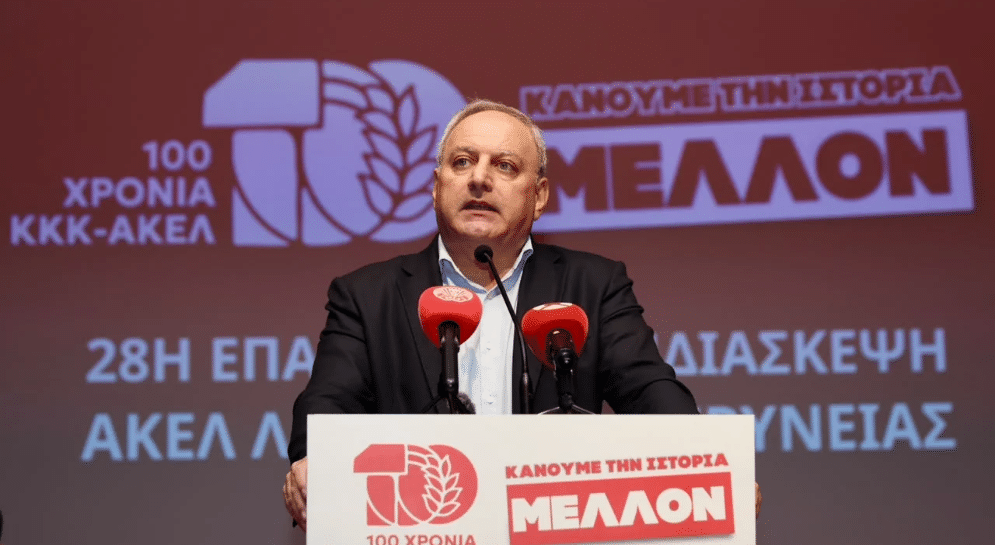
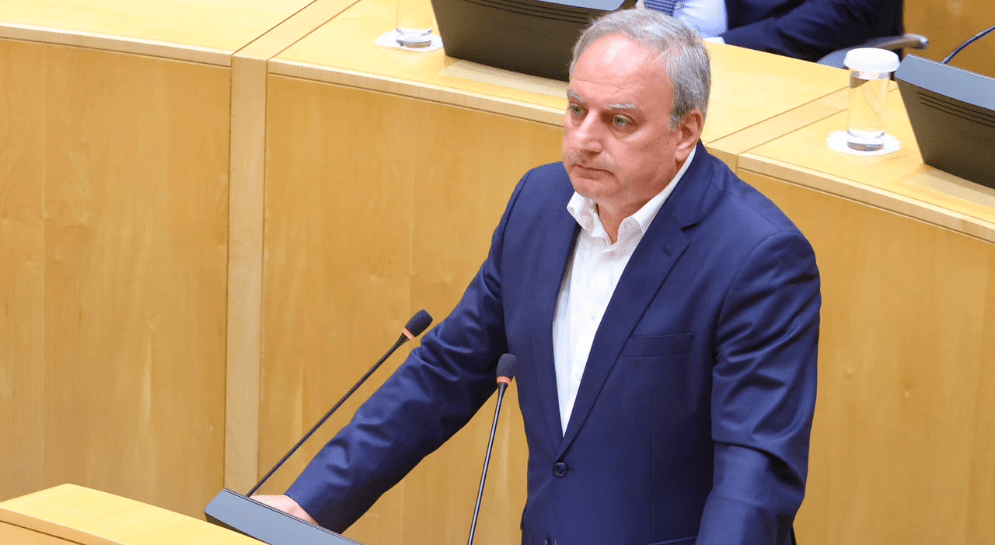
Speech by the General Secretary of AKEL Stefanos Stefanou in the House of Representatives debate on the subject of Energy
19 November 2026, AKEL C.C. Press Office, Nicosia
In European Cyprus in 2026, there is a very serious danger that we will not have sufficient electricity. We are at risk of frequent power cuts. This is, unfortunately, the sad reality we are facing, as:
- We have no natural gas for electricity generation.
- We pay exorbitant prices for electricity, whilst throwing away cheap green energy.
- Critical infrastructure projects remain at a standstill.
- Hundreds of millions of euros are at risk of becoming wasted investments – such as the €150 million for the sixth unit at Vasilikos, which cannot be utilised because it runs on natural gas.
Energy insecurity did not arise out of nowhere. It is the result of political choices that have been made.
Someone must finally take responsibility. The Anastasiades–DISY government created the current chaos. The Christodoulides government, rather than rectifying the situation, continues to manage its consequences by issuing announcements and setting timetables that are constantly being postponed.
And in the meantime, it is the taxpayers who are footing the hefty bill.
- Electricity supply and energy security
The principal and most critical challenge is the adequacy and security of electricity generation.
Our electricity system relies on ageing power stations that are vulnerable to breakdowns. From 1 January 2030, the EU requires the decommissioning of power stations with a total capacity of approximately 720 MW at Dekeleia and Vasilikos, accounting for almost half of conventional electricity generation. And yet, the necessary replacements have not been secured in good time.
The problem has been known for years. AKEL had warned of this. However, the government has been hopelessly slow to activate the power mechanism to meet demand, and it is doubtful whether the target will be achieved.
Faced with this situation, we are very likely to be forced to resort to emergency and very costly solutions, which will cause a sharp rise in the price of electricity.
This is the cost of delay: we are paying more today because some people failed to plan for the future in good time.
If natural gas had arrived on time and if the necessary investments in new power stations, storage facilities and networks had gone ahead, we would not be facing such a dangerous situation today. Energy security, however, cannot be based on ‘ifs’ and risky improvisations.
- The green transition has become an opportunity for windfall profits for the select few
The second problem is that dependence on diesel and heavy fuel oil, combined with the cost of emissions, is keeping electricity prices high.
Over the last decade, the price of electricity in Cyprus has risen by around 76 per cent, almost double the EU average (a 38 per cent increase), whilst around 50,000 households are facing energy poverty.
How is it that a country with so much sunshine has such expensive electricity?
Despite the significant increase in production from renewable sources, its utilisation remains limited. Above all, the lack of storage capacity leads to curtailment of green energy. By 2026, around a quarter of potential renewable energy generation will be lost.
Just think about it: we’re throwing cheap green energy in the bin and continuing to pay through the nose for electricity. The situation would be laughable if it weren’t so tragic.
How did we end up here? Through the haphazard development of large commercial solar farms, without any comprehensive planning or the necessary investment in storage and grid infrastructures.
At the very same time that licences were being granted to private individuals, the semi-governmental Cyprus Electricity Authority (EAC) faced restrictions on the development of its own renewable energy generation, restrictions imposed during the DISY administration. Why, one might ask? Obviously, to serve the interests of certain cronies. By the time the EAC was finally given the go-ahead, much of the available land had already been snapped up by private individuals, some of whom sold the licences for huge profits.
The green transition cannot be green only for the super-profits of a few and black for everyone else’s bills.
- A competitive market on paper, expensive electricity in practice
A third issue is the competitive electricity market, which, instead of coming into effect in 2016, was launched last year – nine years late – but has not led to lower prices because competition is not actually working. The transitional period that was adopted was exploited by powerful interests, causing distortions and generating super profits for some.
- Vasilikos: The energy debacle for which the Cypriot people are paying the heavy price
If there is one project that epitomises the problems with energy policy in Cyprus, it is the natural gas terminal at Vasilikos.
Through procedures riddled with irregularities, in 2019 the DISY government awarded the project to a Chinese consortium, which ultimately led to the termination of the contract and lawsuits amounting to tens of millions against the Republic of Cyprus. We would remind you that the European Public Prosecutor’s Office is investigating the whole matter. Against this backdrop, the DISY government failed to secure natural gas supplies despite having announced it four times.
For a project with an initial budget of around €300 million, the total cost will reach one billion euros. Meanwhile, the ‘Prometheus’ – an investment worth €187 million – has been moored in Malaysia for the past two years, at an annual cost of around €5 million. The President’s assurances regarding the chartering of the vessel have come to nothing. Here I must admit that the current President, who was a key figure in the previous government, has at least learnt not to make firm commitments. He confines himself to issuing assurances….
We are currently in the tendering process to complete the project. Even if everything goes smoothly, the arrival of natural gas is being pushed back to 2030, whilst issues regarding funding, technical completion and the supply of LNG remain unresolved.
There is, however, something even more worrying: we do not know whether the arrival of natural gas will lead to a reduction in the cost of electricity or whether, in the end, we will be generating electricity using natural gas at the cost of oil. LNG prices have risen, infrastructure costs have soared, and the cost of writing off this infrastructure will inevitably be passed on in electricity bills.
- Electricity interconnector: A strategic project does not mean a blank cheque
The second major project facing serious uncertainty is the electricity interconnector with Greece, the much-talked-about GSI. AKEL recognises the strategic importance of the interconnector. However, as this is a costly project, we demand seriousness, transparency and proper documentation.
Seriousness was lacking from the very outset. We all remember N. Anastasiades at a Hollywood-style celebration, switching on the power to the then EuroAsia Interconnector, proclaiming the end of energy isolation. Seven years have passed and we still do not know whether the project will go ahead.
Recent developments, with the resumption of surveys, are certainly a positive step, but they offer no guarantee of completion. The surveys, the laying of the cable, the financing, the viability and the geostrategic benefits all remain unresolved.
The current government is sending out mixed messages. The President’s Office declares that the project will go ahead, whilst the Minister of Finance expresses very serious reservations about the financial impact on the state and society.
The cost of the project was initially estimated at €1.2 billion, then rose to €1.4 billion and now stands at €1.9 billion. Cyprus is covering 63 per cent of the cost, excluding the European grant of €657 million. The Minister of Finance has warned that the final cost could even reach €3 billion.
In such a scenario, the amount we would have to pay would rise to €1.5 billion, without taking into account the returns to investors over the next thirty-five years. At the end of the day, the cost to the consumer will be many times higher.
Speaking of the construction costs of the project, which is approximately 900 kilometres long and reaches a depth of up to 3 kilometres (there is no other project of this depth anywhere in the world), let us look at how much some other undersea power interconnectors have cost:
- France – Spain (length approximately 400 kilometres) rose from €1.9 billion to €3.2 billion (a 68.5 per cent increase on the estimated cost),
- Attica – Crete (length approx. 330 kilometres) rose from €740 million to €1.1 billion (an increase of 48.5 per cent).
- Corinth – Kos (length approx. 400 kilometres) estimated cost €2 billion.
Bearing these examples in mind, one might reasonably conclude that the €3 billion cited by the Minister of Finance for the GSI is perhaps the most optimistic scenario.
Regarding the GSI, there are two possible outcomes: the worst-case scenario is that we will pay for a project that will never be carried out. The Cyprus Energy Regulatory Authority (CERA) has already recognised costs of €82 million, whilst the Independent Power Transmission Operator (IPTO or ADMIE) is claiming much more – with various sources suggesting a figure in excess of €300 million.
Furthermore, the Christodoulides government has committed Cyprus to paying €125 million over the next five years, on the basis of an agreement that is ‘full of holes’, as stated by the Minister for Energy, Mr M. Damianos, without any evidence of the benefits for Cyprus and consumers, as required by the conditions set by the Ministry of Finance. It has already been decided to release the first instalment of €25 million.
The second-worst-case scenario is that we will be paying for many years for a project that will be completed without delivering the benefits to consumers that some people are promising.
These claims are being publicised, with statements being made about savings of hundreds of millions and cheaper electricity. Truly, how can anyone calculate the benefit to the consumer when we do not know what the final cost will be, nor how the cable will behave given its length and the great depth at which it will be laid? As the Vice-President of the European Investment Bank stated, no estimate of the final cost can be confirmed, because the economic assessment is directly linked to technical and contractual details that still need to be clarified.
An electricity interconnector does not, in itself, guarantee either cheaper electricity or energy security. In Europe, there are now many concerns regarding interconnections because they are costly, have failed to prevent rises in electricity prices or ensure system security; for this reason, there is an emphasis on the need for a greater shift towards renewable energy sources, grids and storage. In Europe, too, we are talking about neighbouring countries with land borders and cables of much shorter length than the GSI.
We cannot tackle such a complex project with slogans and public relations assurances. Questions regarding potential benefits have not been answered. Nor have the serious questions regarding ownership arrangements, the Republic of Cyprus’s involvement and control over strategic decisions.
The Christodoulides government is committing our country to payments of hundreds of millions when three key questions remain unanswered:
- how much the project will cost
- when the project will be completed
- who will have control, management and ownership of the cable.
In other words, others are deciding for ‘us’, without us, yet we are already footing the bill, which will run to billions of euros. A telling sign of the situation is the fact that, regarding the sale of the majority stake in GSI to the French company Meridiam, not only did no one consult Cyprus, but the questions raised by both the Ministry of Finance and the Cyprus Securities and Exchange Commission (CYSEC) have still not been answered. We still do not know just how much they are taking us for fools.
The strategic importance of the project is not a blank cheque. Under the banner of upgrading our strategic position, we do not want to end up with yet another failure, nor do we want to be economically and energetically dependent.
AKEL demands full transparency, an independent assessment, a clear definition of the benefits for consumers, guaranteed funding and effective safeguards for the public interest before final decisions are taken.
- Cyprus’s natural gas: We must not end up with exports that bring no benefit
Serious questions also arise regarding the exploitation of natural gas in Cyprus’s Exclusive Economic Zone (EEZ). The government is celebrating investments worth billions without revealing what Cyprus will actually receive.
How much money will the state receive, and when?
What financial terms has it agreed with the companies?
Why are we planning to export our natural gas via Egypt without having considered the possibility of using part of it to meet our own energy needs?
The country’s natural gas must bring real benefits to the economy and society. We must derive substantial benefit from our energy wealth, not just the companies.
Ladies and gentlemen,
The whole situation in the energy sector shows that both the current and former governments view energy not as a public good, but as a source of corporate profit.
And it is not just us who are saying this. The former Minister for Energy, Giorgos Papanastasiou, stated as much, referring to vested interests which, in collusion with political leaders, are preventing cheap electricity. This is an extremely serious statement, to which, however, the government failed to respond. It swept it under the carpet! Why, I wonder? Could it be because the answers are uncomfortable? If we had a fully developed rule of law, certain individuals would already be in prison or at least facing trial. Both the Government and the relevant institutions are hiding and remaining silent.
- AKEL’s energy plan
When the privileged few profit and the many pay the price, we are not merely dealing with mismanagement. We are dealing with a scandalous policy that requires radical change.
Cyprus needs a comprehensive energy plan, with clear priorities, a social focus and public accountability.
AKEL has elaborated specific proposals:
To ensure energy sufficiency and security, we need the rapid completion of critical projects, the replacement of obsolete power stations, the strengthening of centralised and cooperative storage, and a substantial upgrading of the role of the semi-governmental EAC. A special Council for Energy Security and Sufficiency must be established.
For the rational development of renewable energy and storage, it is essential to expedite projects, upgrade the grids, revoke unused licences, launch competitive tenders for new renewable energy and storage projects, and implement targeted energy modernisation plans.
For genuine reform of the electricity market, distortions must be addressed, excess profits must be recouped to fund policies against energy poverty, and mechanisms must be adopted to ensure that low-cost renewable energy generation translates into lower prices.
To reduce energy costs immediately, we propose a permanent 5 per cent VAT rate on electricity, the abolition of double taxation on fuels, the extension of social tariffs, and the allocation of at least 25 per cent of total revenue from emissions charges – which must be earmarked for the energy transition – towards a targeted reduction in electricity bills. In this regard, we demand full transparency regarding the revenue generated from the auctioning of emission allowances and how it is utilised. The Government has left us in the dark despite our repeated questions.
Energy policy is not merely a technical issue concerning infrastructure and major investments. It is one of the most important tools for tackling the cost of living, supporting middle- and low-income earners, and improving citizens’ daily lives. For AKEL, energy is the key fuel in the fight against high prices.
Ladies and gentlemen,
The country’s critical energy situation did not arise of its own accord. It is the result of specific policy choices and specific government responsibilities.
We do not need any more publicity stunts or timetables that will be revised at the next sign of difficulty. We need decisions, a plan, transparency and accountability.
And above all, we need a different approach to energy.
Electricity is not a luxury. It is a social good. It cannot be a privilege for the few and an economic stranglehold for the many.