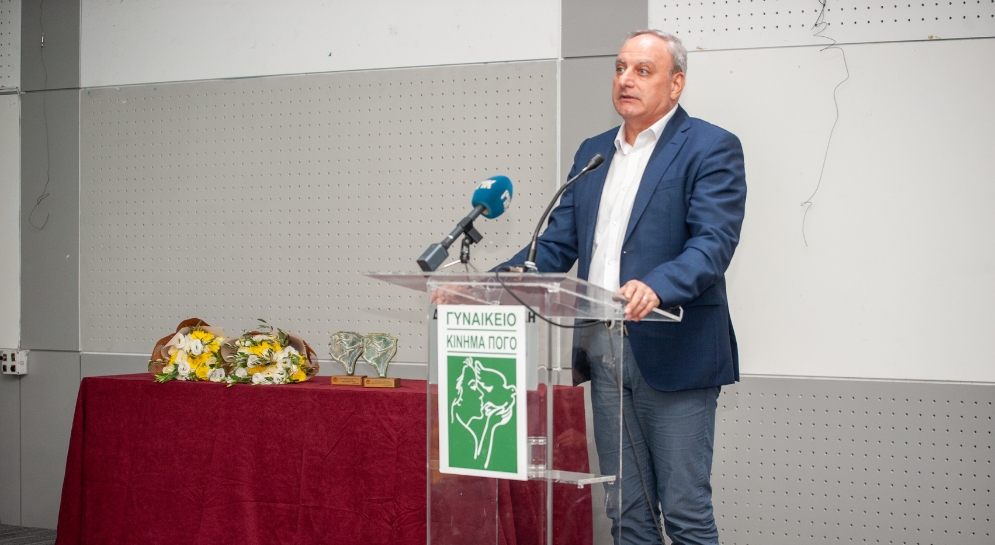
Address by the General Secretary of the C.C. of AKEL St. Stefanou at the 15th Pancyprian Congress of the progressive women’s movement of POGO
23 November 2025
I salute the 15th Pan-Cyprian Conference of POGO. I hope that the decisions your Congress adopts will serve as a catalyst for the women’s movement to become even stronger and even more renewed so that it can continue to fight for the issues that concern women today.
POGO is the most historic women’s movement, with a rich history of struggles and achievements. What are now considered self-evident rights and gains for modern women were demands of the women’s movement with POGO at the forefront, which were achieved after many years of struggle and effort.
The pioneering activists of POGO led the struggles at a time when it was “immoral” and “scandalous” for women to be socially and politically active. At a time and in a system that confined women to the kitchen, the women of POGO showed the way and opened the door for women’s voices to be heard, to grow stronger and to assert equality, equity, equal pay, justice, and dignity.
This is how women’s voices were heard loud and clear in the streets, in factories, in spinning and weaving mills, on construction sites, and in the fields. The pioneering activist women of POGO and those who took up the baton from them organised and mobilised women to march forward, dynamically and decisively, and write their own history, for their own rights, to fulfil their own desires, which they turned into “I can, we can together!”
This is the essence of women’s organization, then and now.
Because the goal remains the same. Equality and equity.
Because women today may seem to have the ability to make their own choices, but how free are they really to do so?
How much do circumstances, mindsets, and stereotypes allow them to do so?
How free is a woman who works in retail seven days a week to be socially and politically active?
How free is a woman who takes care of her children and runs the household to become active in society, political affairs, and culture?
How free is a woman—from stereotypes and obligations—to devote herself to research, science, and climbing the career ladder?
How free is a woman with a family to pursue a professional career? And how free is a woman with a professional career to start a family?
I think each of you in this room, and most of you out there, can answer that question.
She is not free.
Because she works every day—often on weekends too—from morning until night.
Because when she comes home from work, she is overwhelmed with chores and has to find a way to do everything, to balance everything.
Because she has to work twice as hard to prove her worth, even though she is paid less than her male colleagues.
All these are the main factors that expose modern women to greater insecurity, greater poverty, and greater inequality.
According to recent studies, women work almost twice as many hours as men, but are paid less. This is because women are the invisible force in a system that has burdened them with a dual role, at home and at work. The result, as certified by the International Labour Organization, is that women spend 4.5 hours a day on unpaid work at home, which makes them less employable, more dependent and more vulnerable to poverty.
Our country has a consistent rate of gender inequality in the area of poverty. According to the Statistical Service, women at risk of poverty account for 18.5% compared to 15.6% of men. Women participate less in the labor market, are more likely to be in part-time or temporary jobs, and are paid less.
As is logical, this translates into reduced access to housing, health care, and other services, as well as increased exposure to abusive environments. The wage gap remains at 9 to 10%, with all that this implies for the level of pensions, which is reflected in a higher rate of poverty among elderly women.
It is therefore more than necessary; it is crucial and imperative that the women’s movement struggles strongly and decisively to assert solutions to their problems, a way out of dead ends, so that they attain the position that women deserve.
AKEL has been, is, and will remain at the side of the women’s movement, supporting positions, proposals, and initiatives that focus on the needs of modern women. Implementation of legislation on equal pay, regulated labor relations, modern policies for equal participation in parenthood, the creation of childcare and dependent care structures, the improvement and strengthening of social benefits, and policies and practical measures to dismantle gender stereotypes.
With the power of its history and looking to the future, POGO will discuss today, approve decisions, and set out goals and demands for the women’s movement that concern the present and future of modern women. Young women, working women, single mothers, the modern woman who creates and innovates against all odds, against all difficulties.
Before I step down from the podium of your Congress, permit me to mention your General Secretary, my friend and comrade Skevi Koukouma.
Skevi is stepping down from the leadership of POGO because the time has come. No one can defeat time, not even Skevi, who is known for her passion, vitality, and tireless activity. Skevi is stepping down, but she can leave with a clear conscience, because she served the women’s movement, the Left Movement, and POGO with great dedication and success. An example of this success is when you meet foreign personalities at international forums and they ask you what Skevi is doing, emphasizing her activism and fighting spirit. Skevi, thank you. We know that your departure from the leadership of POGO does not mean a withdrawal from public action and social contribution through the ranks of the Left Movement and POGO, of which you are an integral part. All the very best!