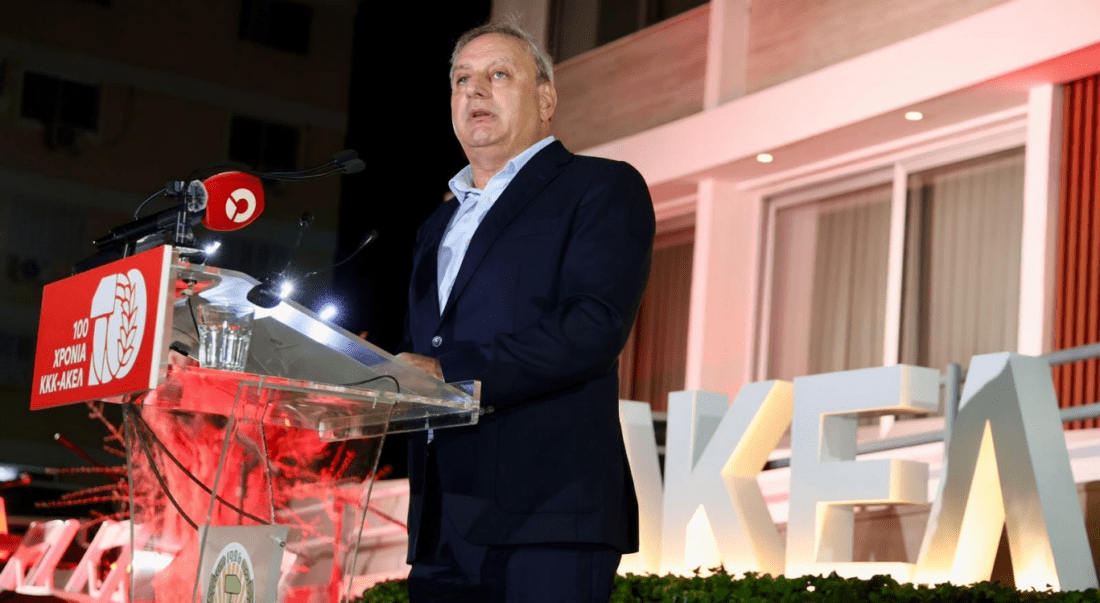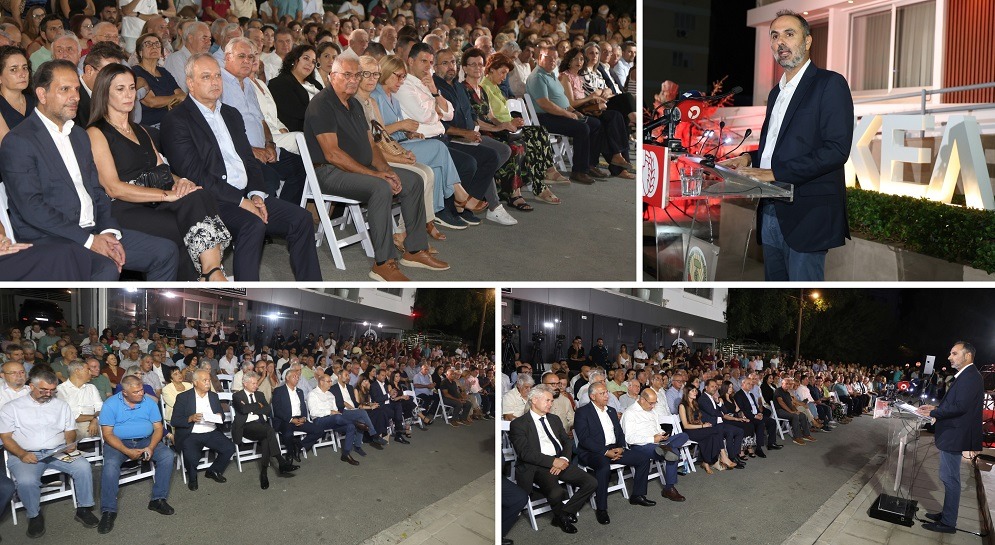
Speech by the General Secretary of AKEL Stefanos Stefanou at the Conference Marking the 100th Anniversary of the Founding of the Communist Party of Cyprus
(Origins, Continuity and Legacy)
16 June 2026, UNESCO Amphitheatre, University of Nicosia
The opening of the Conference—for which I would like to congratulate and thank the University of Nicosia for taking the initiative to organize it—coincides with the anniversary of June 16, 1943, when the Central Committee of AKEL decided to mobilize its cadres and members in the pan-European and global struggle against Hitlerite fascism. This decision was a natural extension of AKEL’s declared ideological and political character, as the party was founded in April 1941 as a “Democratic, Anti-Fascist, Anti-Hitler” party. The decision to take a stand against fascism marks a milestone in the Party’s hundred-year history.
Since we are speaking about AKEL, allow me to remain on this topic, even though the main focus of the Congress revolves around aspects of the history of the Communist Party of Cyprus CPC. I will focus on AKEL because the Party’s centennial concerns both the CPC and AKEL, since AKEL is the party that succeeded it. In their combined 100-year history, the CPC accounts for a total of 18 years, while AKEL accounts for 85 years. As is well known, there was a three-year period during which the two parties coexisted, when, in 1944, the decision was made to incorporate the CPC into AKEL.
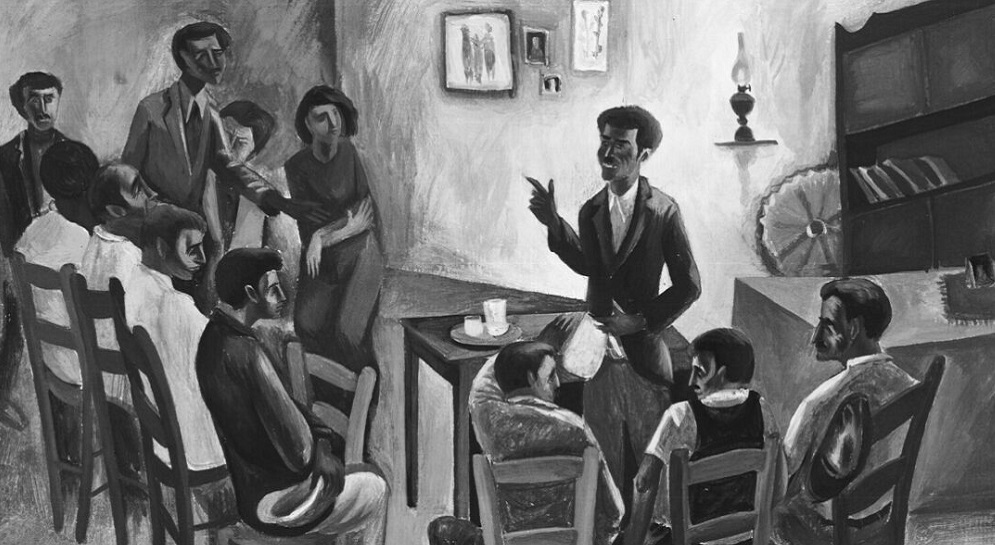
The founding of AKEL was a decision made by the leadership of the then-illegal CPC, with the late Ploutis Servas serving as General Secretary. The rationale behind the founding of AKEL is rooted in the decisions of the 3rd Congress of the CPC, which took place in 1936. According to the book by Alexis Alekou and Spyros Sakellaropoulos, *History of the CPC (1923–1944)*, this Congress highlighted the need to place greater emphasis and attention “on the legal trade union activities of CPC members rather than on the illegal operations of communist cells.”
It was also emphasized that the Party should not limit itself to propagandizing revolutionary positions, but should engage in open action, prioritizing the advancement of labour demands in order to win popular support.
Based on this position, a year later, in 1937, the decision was made for the CPC to lead the effort to “organize a broad-based Party…. “The CPC, as a militant party and a party of direct action, never abstains from any issue that may arise and which captures the attention of the working classes” (p. 140). This resolution also noted that the Party “is obliged to rally around it not only all the capable and strong elements of the working class and the working strata, but also all those elements of the petty bourgeoisie and the bourgeoisie who consciously wish to fight either for the expulsion of the British or even for the attainment of significant constitutional freedoms.”
The “broad-based party,” as the 1937 resolution characteristically put it, was AKEL, in whose founding—in addition to CPC cadres—participated figures who not only had no connection to the communist left but generally did not identify themselves as part of the Left. The participation of these figures in the newly formed party was based on their alignment with the priorities of the Party’s political agenda.
AKEL, taking up the baton from the CPC, deepened and enriched the position that the Party is “one of direct action that does not advocate abstention” on the dominant issues of the day and does not remain indifferent to the issues that capture workers’ attention, even if these are limited by the framework and conditions of capitalism. What did this decision mean in practice? It meant that the Party began to place greater emphasis on how it could gain the ability to advance its political agenda, which grounded its socialist vision in the problems of workers and the issues facing society and the country. AKEL stressed open and mass-based work with workers and society, now taking into account the level of consciousness of the masses—that is, their attitudes, priorities, sensitivities, and perceptions.
As a natural extension of its openness toward society, the Party set before itself the challenge of, on the one hand, how to create the conditions that would enable it to address the masses, inspire them, and mobilize them, and, on the other hand, how it would succeed in uniting forces through alliances that would improve the prospects for implementing its political agenda.
This new political philosophy, which quickly became established as the guiding principle of the Party’s actions, defined AKEL’s identity and character as a party that grounds its political program in the specific context of the times. An outward-looking approach to action and a policy of alliances became part of AKEL’s DNA.
It is precisely these elements that have helped the Party not only to become a mass movement but also to play a leading role and influence the country’s political and social landscape. And it did so, of course, without compromising its ideology or abandoning its ultimate goal of building a socialist society.
It is this political philosophy that transformed AKEL from a party for its own sake into a party for its class, for society, and for the country as a whole. This policy, which AKEL has developed over time, has a profound Leninist foundation and echoes the need to create the conditions for achieving a leading role in the country’s political and social developments—to recall, in part, the ideas of Antonio Gramsci.
AKEL’s political philosophy is grounded in conscious and collective action within specific historical conditions, seeking to shape the conditions that will enable social transformation for the benefit of working people and, more broadly, of society.
In this way, necessity becomes history: not through abstention or rhetoric that fails to resonate with the people, but through the difficult and complex process of conscious participation and collective action within the framework of the existing system. Here, the Party must possess the dialectical ability to participate and act without, however, becoming assimilated and losing its bearings.
AKEL, with socialism as its vision, has never ignored or dismissed the need to engage in politics in the “present” with an eye toward the “future.” It has never refused to participate in the processes and political developments within the system. AKEL has never postponed solutions to problems to some indefinite future, when and if socialism prevails. If it had done so, it would have nullified and negated the Party’s historical role and forfeited the ability to intervene in developments for the benefit of the many rather than the few and the privileged.
After all, Marxism is not content merely to interpret the world. It seeks to change it. This is the deeper meaning of Marx’s famous 11th Thesis on Feuerbach: “Philosophers have only interpreted the world. The point is to change it”. Change, however, does not arise from theory and interpretation alone. It becomes a reality through collective action and intervention in the key issues of each historical period—for workers, for society, and for the country.
This is precisely what AKEL has been doing for 100 years now, leaving a strong mark on every stage of Cyprus’s and its people’s journey. To overthrow colonial rule, to defend and strengthen our country’s independence, to defend its freedom, and to safeguard democracy against fascism. To achieve economic development and to ensure the prosperity and progress of society.
In this way, AKEL will continue to conduct its political activities in its second century. Drawing on the momentum of its history and the strength of its rich political experience, without ever betraying itself, the ideology it espouses, or the historical subject it represents.
I wish the Congress every success in its deliberations.